
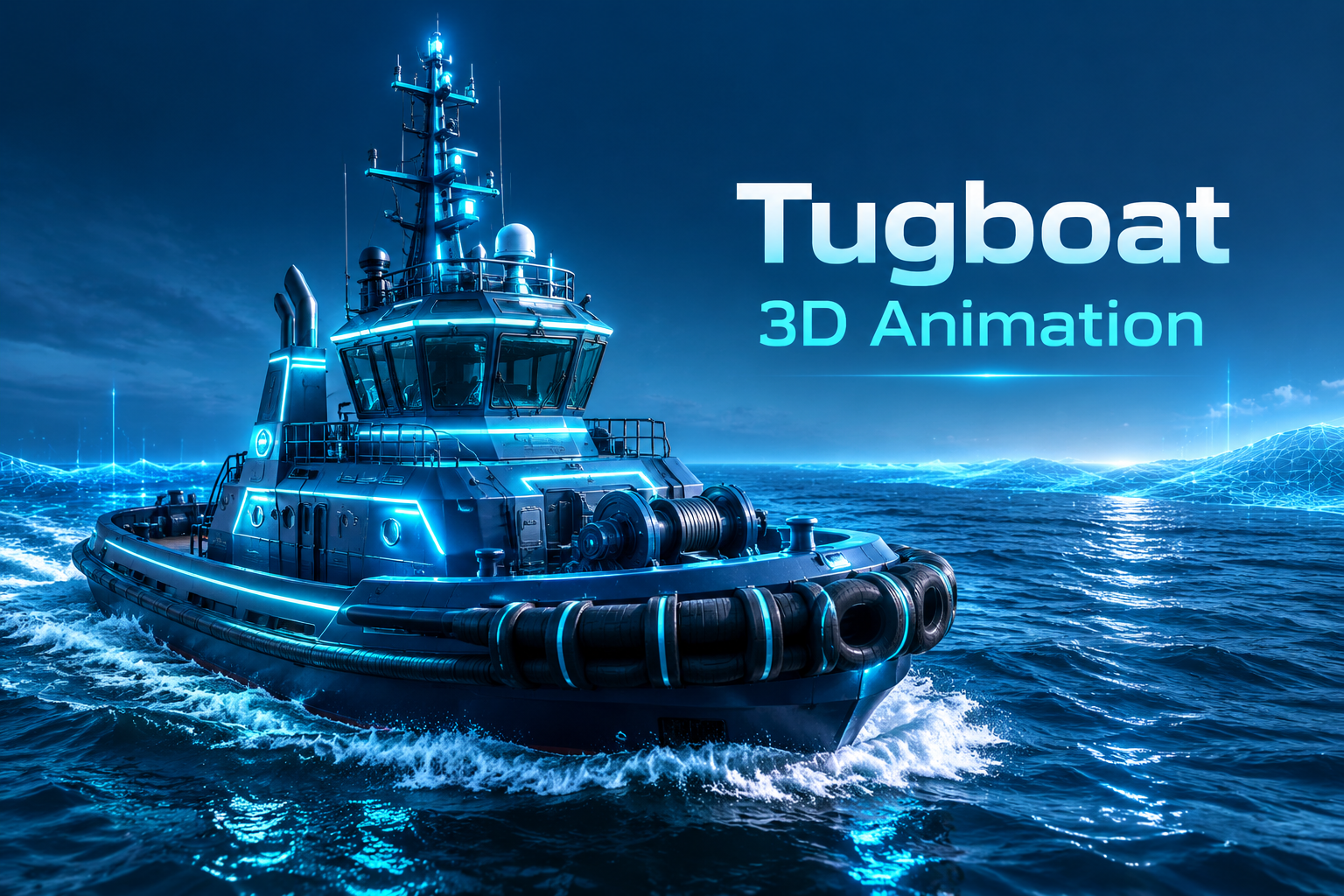
The maritime and offshore industry operates in some of the world’s most unforgiving, unpredictable, and capital-intensive environments. Within this sector, tugboats serve as the indispensable workhorses responsible for precision vessel handling, escorting, berthing, anchor handling, and complex offshore salvage operations. As naval architecture evolves and ultra-large vessels demand significantly higher bollard pull capacities, demonstrating the engineering complexity and hydrodynamic behavior of modern tugs has become an essential and critical challenge. This is where Tugboat 3D Animation emerges as an exceptional and high-impact asset for offshore contractors, naval architects, and offshore operators.
In this comprehensive guide, we explore the vital role of photorealistic, physics-compliant 3D animation in bridging the gap between theoretical naval architecture and field operations. You will learn why generic stock models fall short in critical engineering projects, how computational fluid dynamics (CFD) and rigid-body physics integrate with visual storytelling, and how 3D animation mitigates operational risks while accelerating high-stakes commercial deal-making.
The Strategic Role of Tugboat 3D Animation in Modern Naval Engineering
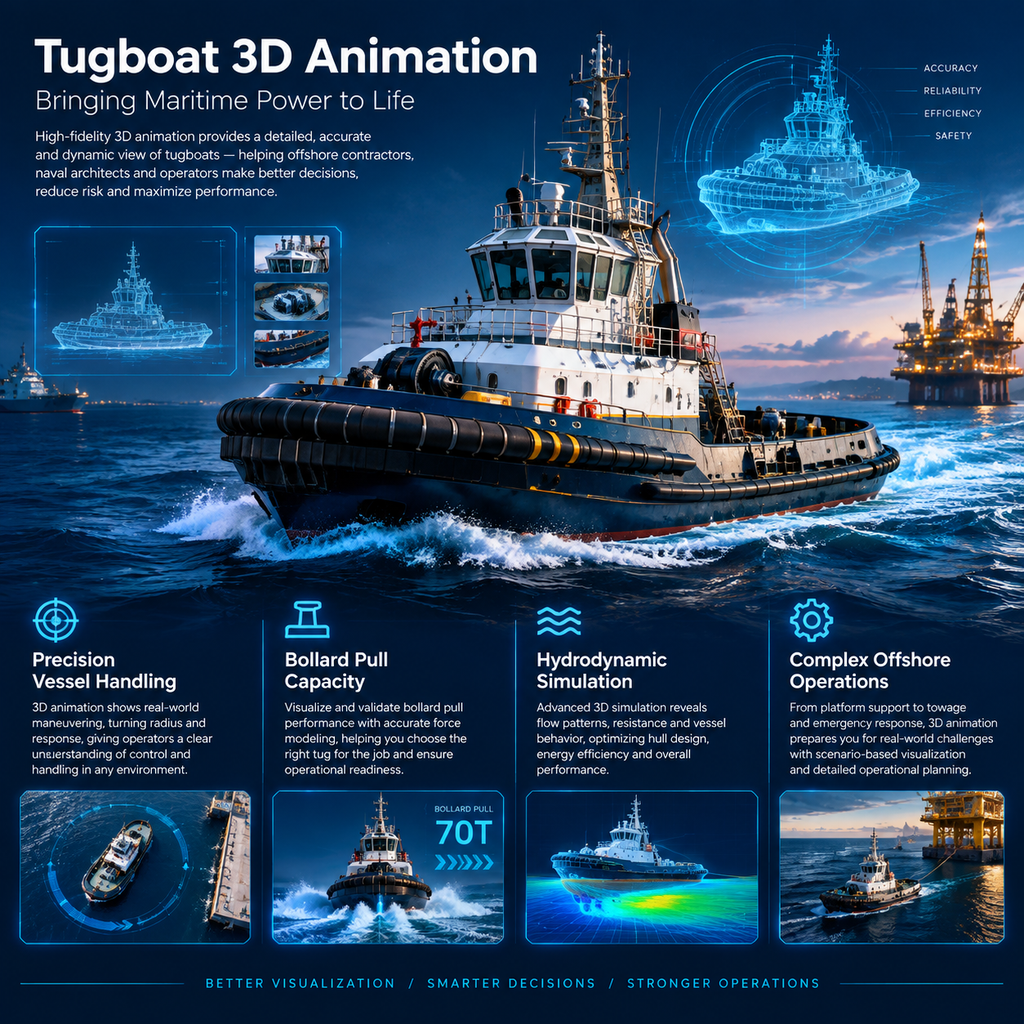
Tugboats are not merely standard watercraft; they are highly concentrated thrust-delivery platforms engineered to exert immense directional forces under dynamic hydrodynamic loads. In modern naval architecture, presenting structural modifications, hybrid propulsion systems, and advanced hull designs demands visual tools that far exceed the capabilities of 2D blueprints or static renders, and conventional industrial 3D simulation workflows.
Advanced 3D animation acts as an engineering translation layer, enabling naval architects to showcase sophisticated mechanical systems—such as Schottel Rudderpropellers, Voith Schneider Propulsion (VSP), and escort skegs—in full operational motion.
Key Benefits for Naval Engineering Teams:
- Interactive Design Validation: Visualizing how optimized hull geometries slice through turbulent seas and identifying potential vortex shedding around thruster azimuths prior to steel cutting and fabrication.
- Exploded Mechanical Views: Showcasing heavy-duty towing winches, quick-release hooks, dynamic braking systems, and auxiliary diesel-electric power units in synchronized mechanical harmony.
- Interdisciplinary Alignment: Enabling non-technical project stakeholders, port authorities, and regulatory bodies to instantly comprehend complex engineering solutions without deciphering hundreds of CAD drawings.
Why Generic Stock 3D Models Fail in Industrial Applications
Numerous online platforms offer vast libraries of 3D tugboat models. While these assets may suffice for artistic concepts, video games, or background renders, they are fundamentally inadequate for rigorous offshore and engineering applications.
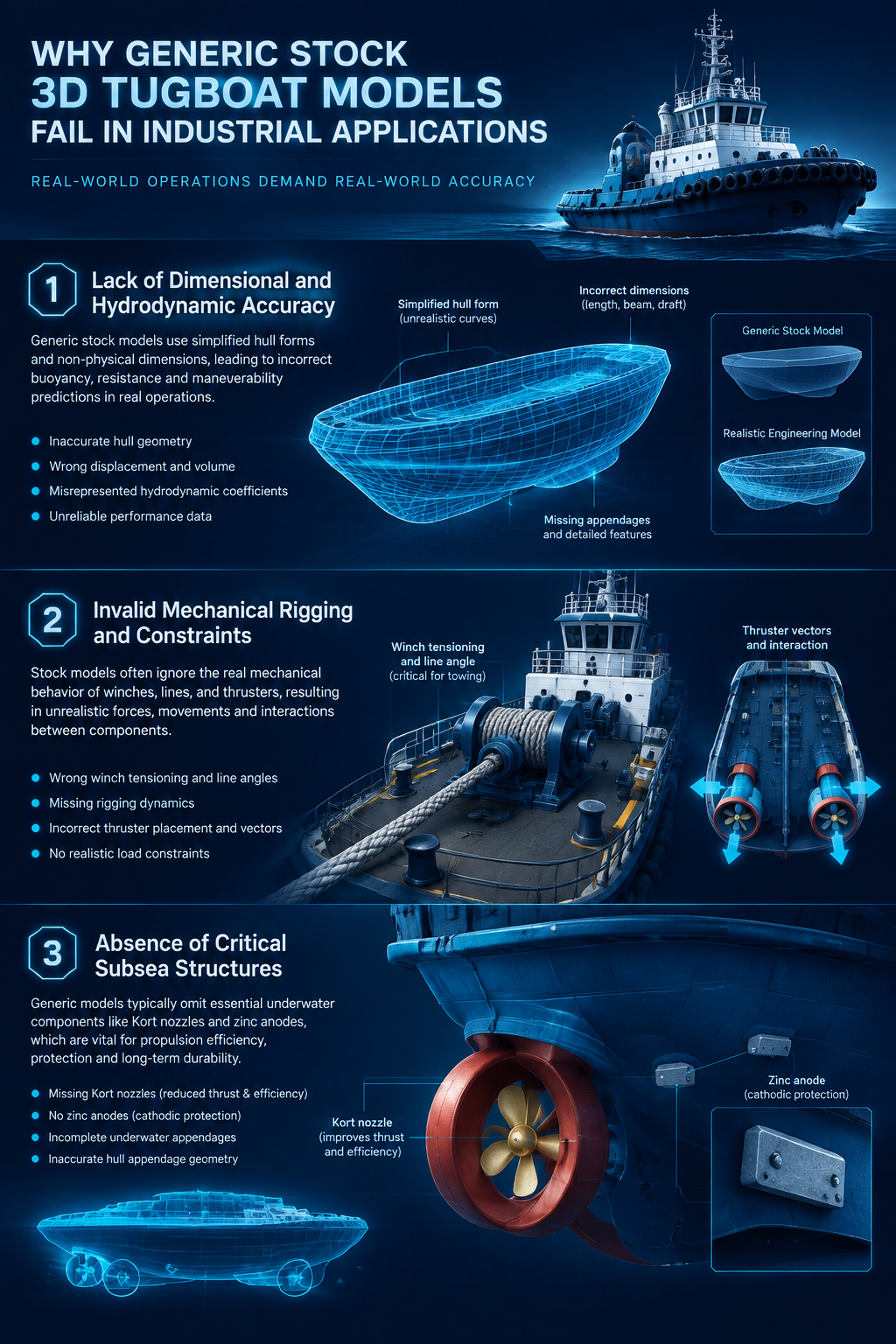
Commercial maritime engineering demands mathematical accuracy, not artistic approximation. The shortcomings of stock models are evident across three critical dimensions:
- Lack of Dimensional and Hydrodynamic Accuracy: Stock models are built purely for aesthetics, lacking accurate hull lines, true waterline buoyancy parameters, and exact engineering scale proportions.
- Invalid Mechanical Rigging and Constraints: Real-world tug operations rely on intricate winch tensioning, line deflection angles, dynamic hawser behavior, and 360-degree azimuth thruster vectors—features completely absent in generic assets.
- Absence of Critical Subsea Structures: Most stock models omit vital below-the-waterline elements, such as anti-cavitation tunnels, sacrificial zinc anodes, Kort nozzles, and hydrodynamic skeg profiles.
- The same level of technical accuracy is essential in subsea pipeline inspection animation, where underwater structures, inspection routes, and subsea equipment must be represented with engineering precision.
Relying on off-the-shelf stock models introduces severe credibility risks during tenders and can lead to catastrophic misconceptions in operational training. Industrial-grade visualizations require custom modeling directly derived from native CAD, STEP, or IGES engineering datasets.
Simulating Ocean Physics: Towing Dynamics, Hydrodynamics, and Sea States
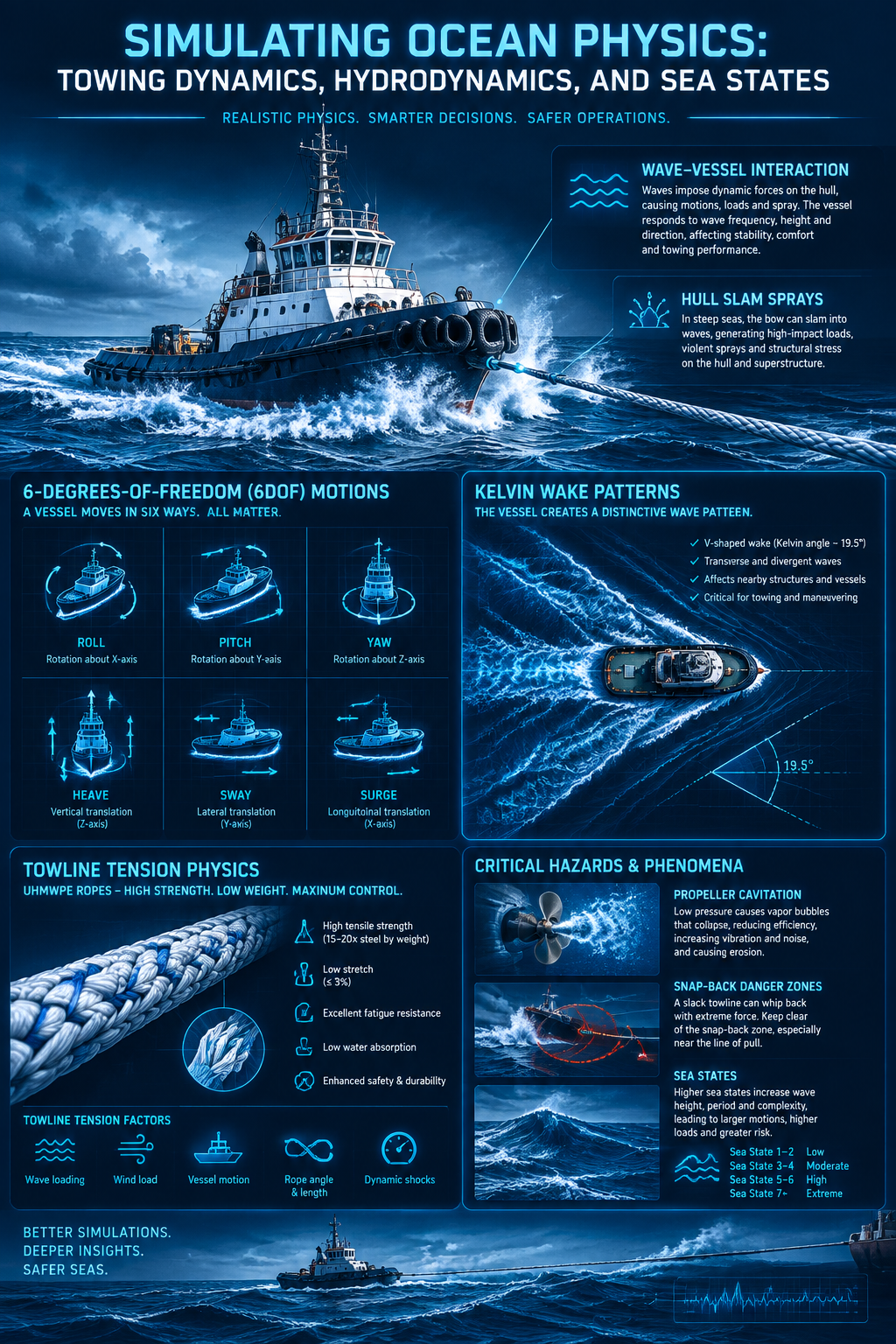
The hallmark of high-tier industrial 3D animation is the mathematically grounded representation of maritime physics. A tug operating in open waters or severe sea states is subject to extreme 6-Degrees-of-Freedom (6-DoF) vessel motions: Roll, Pitch, Yaw, Heave, Sway, and Surge.
Specialized visualization studios leverage advanced particle systems and fluid dynamic solvers to simulate:
- Wave-Vessel Interaction: Kelvin wake patterns, bow wave propagation, hull slam sprays, and turbulence generated by high-power thruster cavitation.
- Towline Physics and Catenary Curves: The behavior of Ultra-High-Molecular-Weight Polyethylene (UHMWPE) synthetic lines and steel wire ropes under dynamic loads, including snap-back danger zones and fluctuating line tension during emergency stop maneuvers.
- Turbulent Propeller Wash: High-velocity vortex currents generated by multi-megawatt propulsion systems, particularly during harbor-assist maneuvers in shallow-water berths.
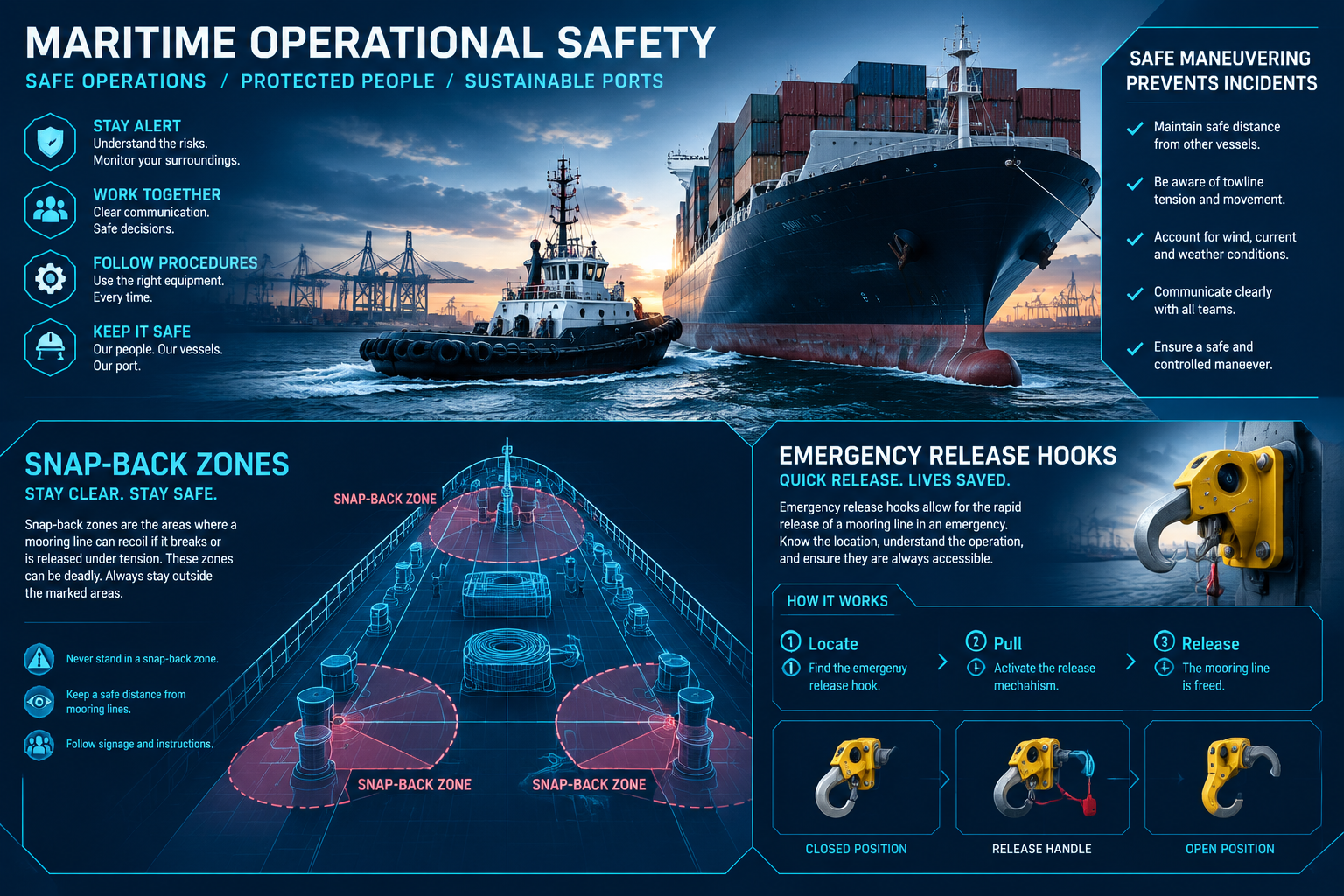
Operational Safety, Port Authority Training, and Crew Briefing
Towing operations are inherently high-risk. From the danger of girting (tripping and capsizing due to lateral towline forces) to line parting and high-speed collision hazards, safety protocols must be communicated with absolute clarity.
Key Advantages in Safety Programs and Personnel Training:
- Visual Snap-Back Zone Mapping: Clearly illustrating hazardous deck zones to prevent fatal injuries in the event of sudden towline failure.
- Emergency Release Protocols: Step-by-step mechanical demonstrations of quick-release towing hooks operating under maximum rated bollard pull.
- Complex Multi-Tug Maneuvers: Visualizing coordinated escort strategies for Ultra Large Container Vessels (ULCV) and LNG carriers navigating narrow channels under severe crosswinds.
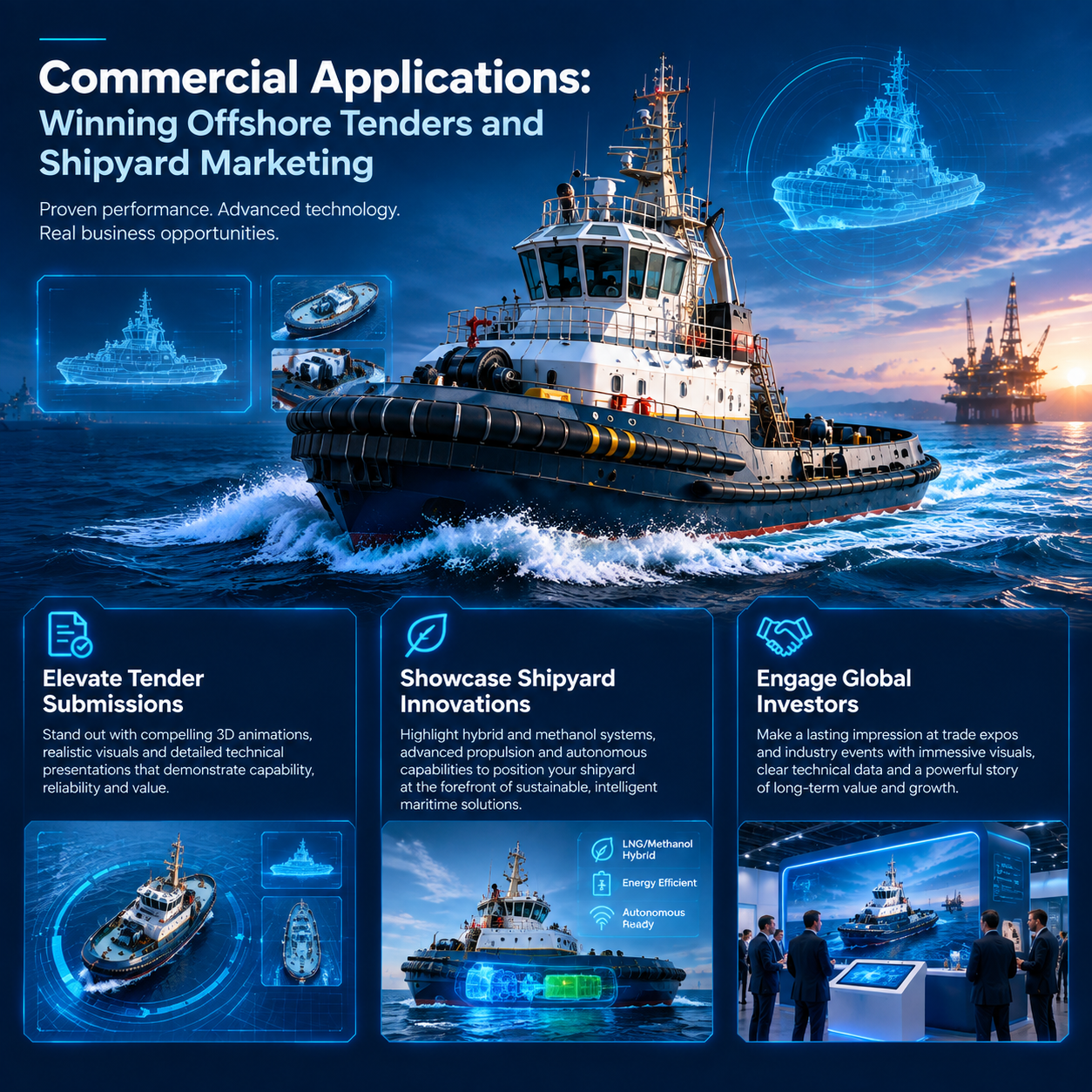
Commercial Applications: Winning Offshore Tenders and Shipyard Marketing
In the B2B maritime market, securing contracts for offshore wind farm installations, oil and gas rig moves, and long-term charter agreements hinges on distinctive technical and visual presentations.
A high-impact 3D animation empowers commercial teams to:
- Elevate Tender Submissions: Replace dense text reports with photorealistic 3D animations that visually articulate step-by-step towing, salvage, or positioning methodologies.
- Showcase Shipyard Innovations: Market proprietary hull designs, eco-friendly hybrid/methanol propulsion systems, and autonomous towing capabilities long before physical construction begins.
- Engage Global Investors at Trade Expos: Display cinematic 4K animations at international maritime exhibitions such as Posidonia, Nor-Shipping, or SMM Hamburg to drive commercial vessel orders.
Behind the Scenes: Technical 3D offshore Animation Production Pipeline
Creating an industrial-grade maritime animation requires a structured, multi-stage workflow that blends engineering precision with cinematic visual effects:
- CAD Ingestion and Optimization: Converting and retopologizing native engineering datasets (Rhino, SolidWorks, CATIA, etc.) into optimized 3D assets while preserving millimeter-level precision.
- Kinematic Rigging and Mechanics: Building precise motion hierarchies and mechanical constraints for all moving components, from deck cranes and towing pins to azimuth thrusters and radar arrays.
- Environmental FX and Hydrodynamic Simulation: Configuring ocean conditions based on the Beaufort scale, combined with realistic foam, surface spray, and particle dispersion simulations.
- Physically Based Rendering (PBR) Texturing: Applying offshore-grade protective coatings, non-slip deck finishes, anti-fouling weathering, rust, and salt spray deposits for maximum realism.
- Compositing and Technical Data Overlay: Integrating final renders with on-screen telemetry overlays, including live bollard pull readouts, velocity vectors, line tension gauges, and GPS coordinate tracking.
Conclusion
As digital transformation accelerates across the offshore and offshore sectors, ultra-realistic, engineering-accurate visualizations are no longer optional they are essential to project success and commercial growth.
To discuss your technical animation requirements and receive a customized project proposal, contact Fidar Animation today and take the next step toward elevating your maritime business.