
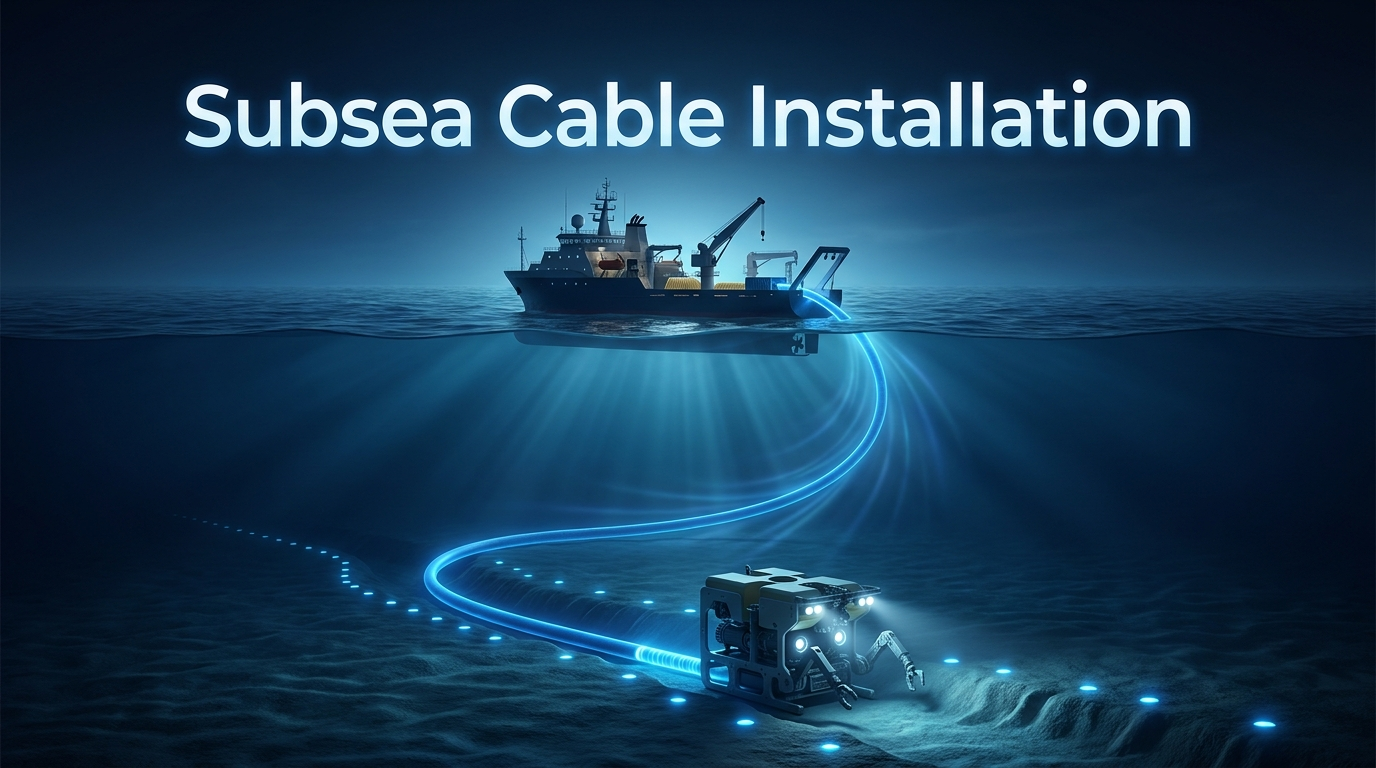
A Comprehensive Guide to Subsea Cable Installation Animation: A Revolution in Offshore Engineering
Imagine installing thousands of miles of fragile, high-voltage cables on the dark, turbulent ocean floor. Subsea cable installation is one of the most complex, hazardous, and costly engineering processes in the modern world. Whether connecting offshore wind farms to the main grid or linking continents with high-speed communication networks, the margin for error is virtually zero. This is where subsea cable installation animation emerges as a completely transformative factor. These animations bridge the critical gap between complex offshore operations and clear, practical communication by converting dense engineering data into stunning, physically accurate 3D visuals. In this comprehensive guide, we will explore how subsea cable animations are revolutionizing the offshore industry, reducing risks, and securing multi-million dollar investments. Join us in this article from Fidar Animation.
Why is 3D Animation Crucial for Offshore Projects?
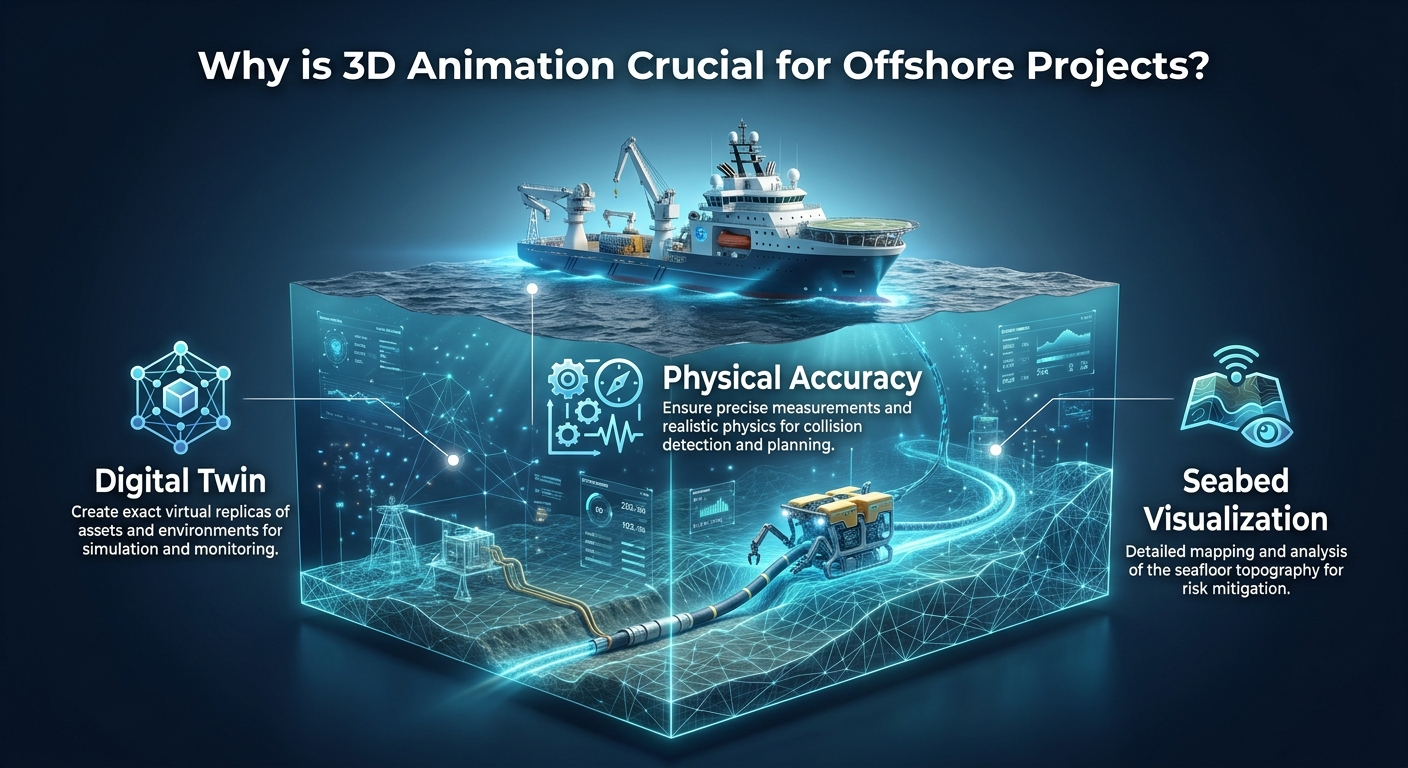
The offshore energy and marine telecommunications sectors operate in environments invisible to the naked eye. Engineers, investors, and project managers cannot simply “look” at the seabed to understand project progress. Traditional 2D maps and technical manuals, though essential, often fail to convey the dynamic and spatial realities of deepwater cabling and struggle to effectively communicate complex concepts.
Subsea cable installation animation solves this problem by creating a Digital Twin of the operation. Using advanced 3D rendering software, engineering companies can simulate every second of the installation process. The goal isn’t just to create beautiful images; it’s to generate physically accurate simulations that consider water depth, vessel dynamics, cable tension, and seabed topography. At Fidar Animation, our expert team takes action in this regard and assists you in this difficult and complex process by creating high-quality animations.
-
Bridging the Communication Gap
Projects of this magnitude require approval from a diverse group of stakeholders, including government regulatory bodies, environmental organizations, and non-technical investors. An accurate and high-quality animation allows stakeholders to easily visualize the entire process. This tool transforms abstract mathematical models into a compelling visual narrative that is understandable to everyone, thereby expediting approval and funding stages.
-
Risk Reduction and Clash Detection
Before even a single vessel leaves port, engineers can use animation to test their methods. By visualizing the subsea environment, teams can identify potential hazards such as protruding rocks, existing pipelines, or steep seabed slopes. Clash Detection in a 3D animated environment ensures that cabling equipment, such as Remotely Operated Vehicles (ROVs) and trenching machines, will not interfere with existing subsea infrastructure.
read more : The Comprehensive Guide to Offshore Construction Sequence Animation: Visualizing Maritime Excellence
Key Subsea Cabling Stages Depicted in Animations
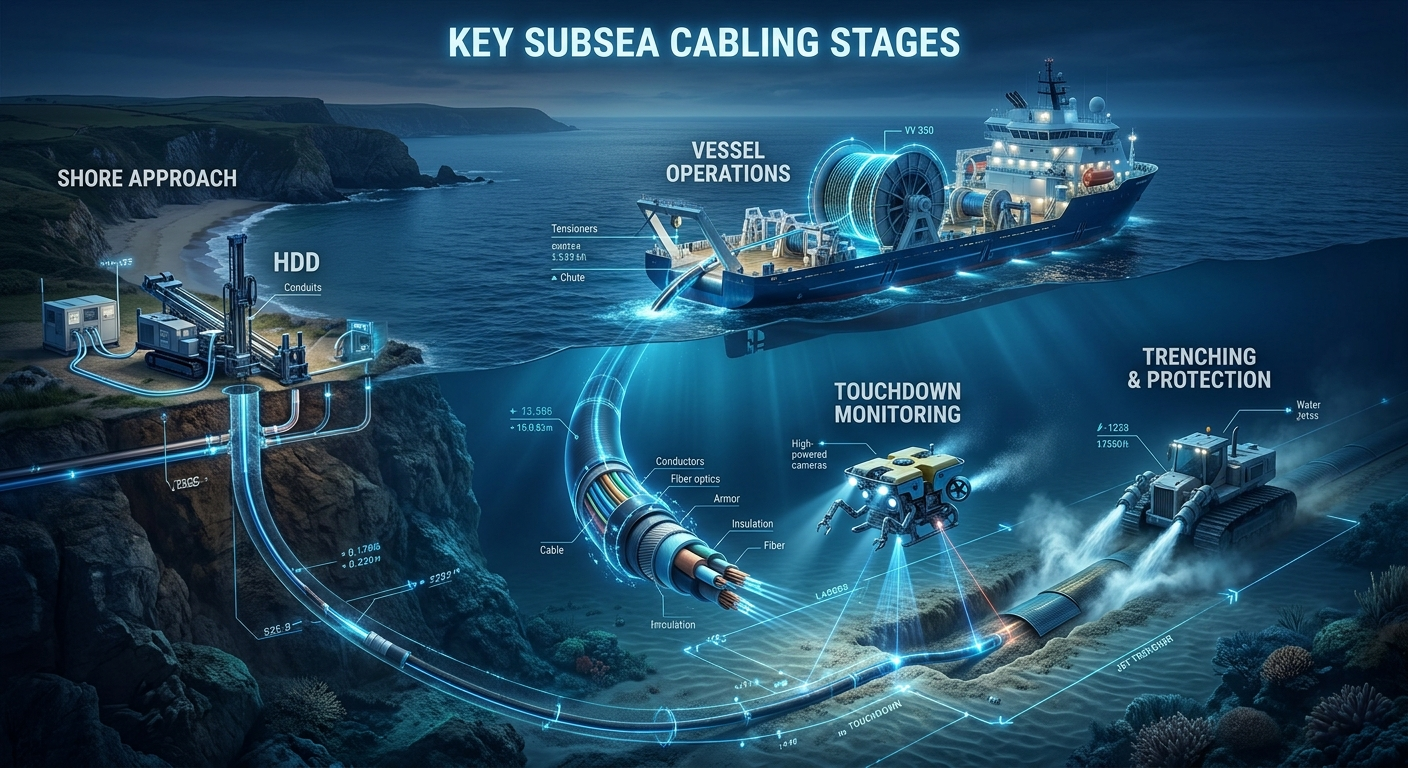
A high-quality subsea cable installation animation typically guides the viewer through the entire project lifecycle. Here are the important stages that these animations illustrate:
- The Shore Approach: The point where the subsea cable reaches land is often the most environmentally sensitive and technically challenging part of the route. Animations beautifully illustrate the process of Horizontal Directional Drilling (HDD) or open trenching. Viewers can see how the cable is pulled from the offshore vessel, through a pre-drilled conduit, and safely enters the onshore power substation without disturbing the local coastal ecosystem.
- Vessel Setup and On-Deck Operations: A significant portion of the animation focuses on the surface. Cable Laying Vessels (CLVs) are massive floating factories. Animations detail the complex deck layout, depicting huge rotating carousels loaded with thousands of tons of cable. They show how tensioners, chutes (guideways), and compensators work in harmony to guide the cable into the ocean at a controlled speed, preventing it from snapping or tangling under its own weight.
- Touchdown Monitoring and ROV Operations: As the cable descends into the depths, the animation’s perspective shifts underwater. This is a critical view that is impossible to comprehensively capture with real cameras due to the darkness and turbidity of the water. The animation shows the “touchdown point” (the precise location where the cable hits the seabed). It also highlights the vital role of ROVs, which move alongside the cable, monitor the touchdown process, and ensure the cable is laid exactly along the engineered route.
- Trenching and Protection: Simply laying a cable on the seabed is rarely sufficient. To protect it from falling anchors and commercial fishing nets, the cable must be buried. Animations provide clear cross-sectional views of trenching machines and subsea plows at work. Viewers can observe how jet trenchers use high-pressure water to liquefy the seabed, allowing the cable to sink to a safe depth before sediments resettle over it.
The Engineering Behind the Animation
What distinguishes a standard animation from a professional subsea cable installation animation, like those from high-caliber companies such as FIDAR ANIMATION, is engineering precision.
Professional animators in the offshore sector don’t just guess how a cable bends. They utilize Finite Element Analysis (FEA) and dynamic simulation data provided by marine engineers. Animations adhere to precise physical parameters:
- Minimum Bend Radius (MBR): The animation ensures that the cable never bends beyond its physical limits.
- Catenary Curve: The shape of the cable as it hangs between the vessel and the seabed is calculated based on water depth, vessel speed, and cable weight.
- Environmental Forces: Advanced animations can simulate ocean currents, wave heave and pitch, and vessel drift, showing how the vessel’s Dynamic Positioning (DP) system compensates for these forces to keep the operation on track.
Benefits for Marketing and Bids
In the fiercely competitive world of offshore energy, winning a contract often depends on who can present the most confident and understandable execution plan.
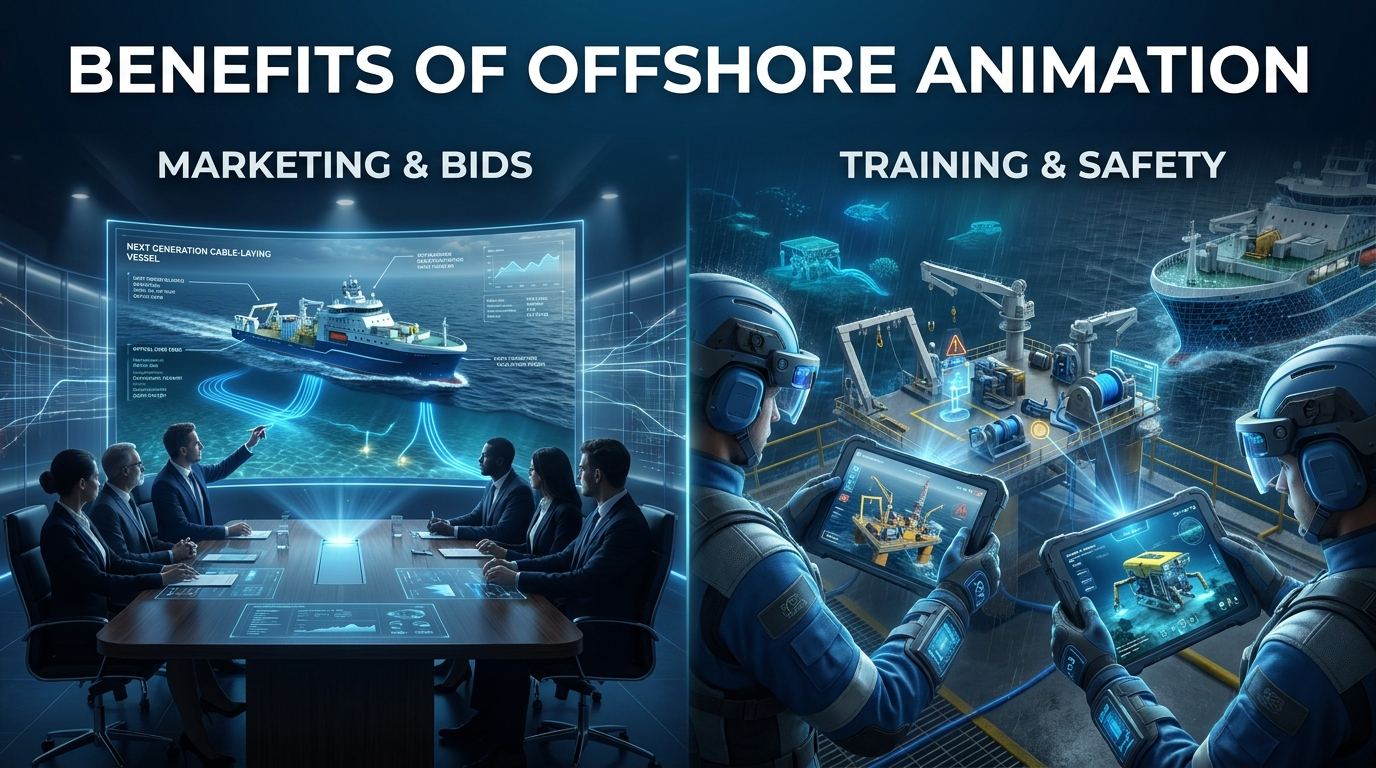
When bidding for a new offshore wind farm or cable interconnection project, companies use subsea cable installation animations as the centerpiece of their presentation. Instead of providing a 500-page method statement to the client, a contractor can present a 3-minute video that flawlessly illustrates their proposed methodology, equipment, and timeline.
These accurate visuals lead to a high level of project understanding for clients. This demonstrates to the client that the contractor has deeply considered all aspects of the installation, anticipated potential problems, and developed practical solutions. It is a powerful marketing tool that elevates a brand from a standard contractor to a modern and advanced industry leader.
Training the Next Generation of Offshore Personnel
Beyond marketing and project planning, these animations serve as invaluable training tools. Operating cable-laying equipment requires extraordinary skill and coordination.
Before new crew members step aboard a vessel, they can study detailed animations of the precise procedures they will perform. By visualizing the deck layout, the operation of tensioners, and the deployment of ROVs, crew members gain a comprehensive understanding of the workflow. This visual training reduces familiarization time, improves operational efficiency, and, most importantly, enhances safety on deck. When everyone understands the big picture, the risk of communication misunderstandings and accidents is significantly reduced.
Conclusion
As global demand for renewable energy and high-speed data connectivity continues to increase exponentially, so too does the volume of subsea cables being installed across the world’s oceans. The success of these massive projects hinges on meticulous planning, flawless execution, and transparent communication.
Subsea cable installation animation is no longer just a luxury or a marketing gimmick; it is an essential component of offshore engineering toolkits. By providing physically accurate, highly detailed, and engaging visual narratives, these animations reduce risks, secure investments, and ensure that the vital lifelines of our modern world are installed safely and efficiently. Whether you are an engineering firm looking to win your next bid or an investor seeking to understand your project milestones, embracing 3D subsea animation is the clearest path to success. To view Fidar Animation’s portfolio and order an animation, contact our specialized team and present complex concepts simply and understandably to your target audience.