
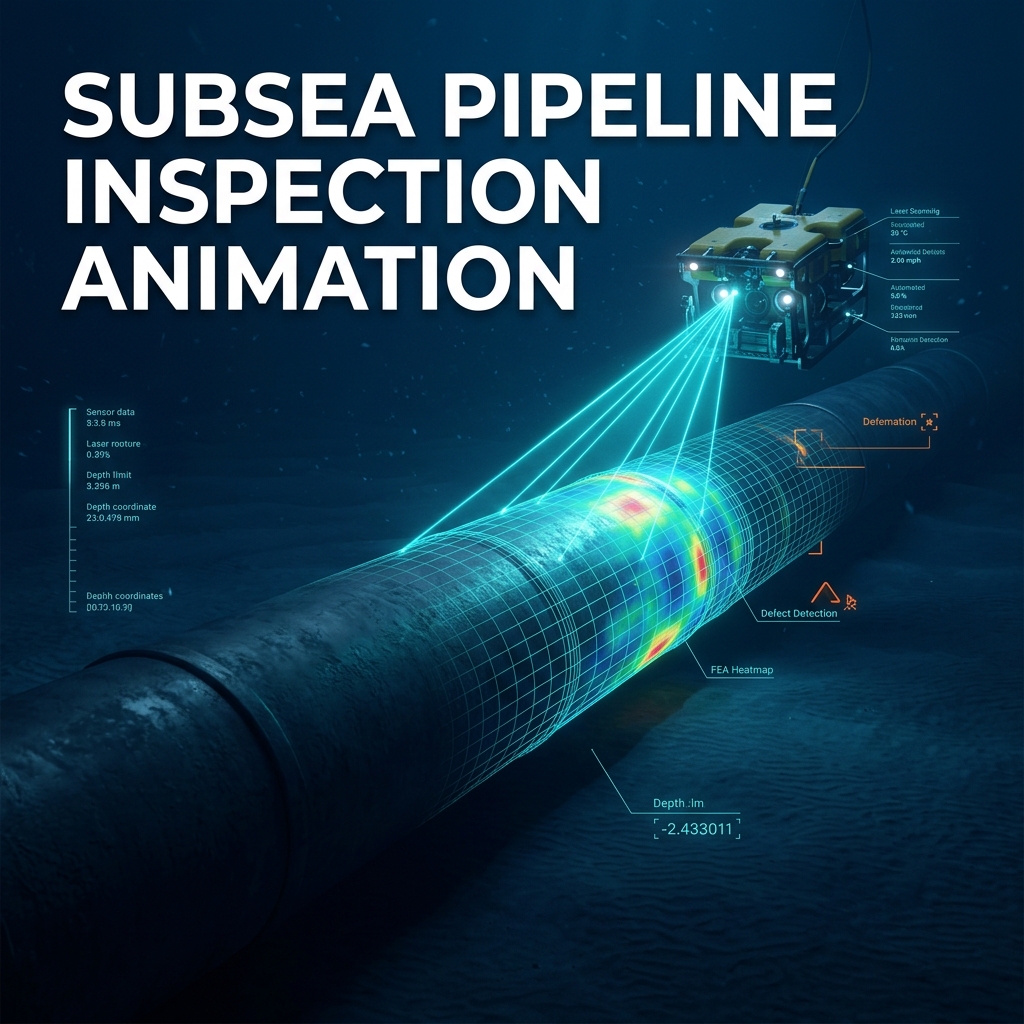
Hidden hundreds or even thousands of meters beneath the ocean’s surface lies a vast, intricate network of pipelines that serve as the circulatory system of the global energy industry. These subsea arteries transport millions of barrels of oil and billions of cubic feet of natural gas every single day. However, this harsh, high-pressure, and corrosive marine environment poses a constant threat to pipeline integrity. To prevent catastrophic leaks, environmental disasters, and massive financial losses, energy companies must conduct rigorous, ongoing inspections. But how do you communicate the highly complex, technical procedures of deepwater inspection to stakeholders, investors, and crew members who are miles above the surface? The answer is subsea pipeline inspection animation.
This comprehensive article serves as your ultimate guide to understanding the transformative role of $3$D animation in offshore integrity management. We will explore the critical need for these visual tools, the specific underwater operations they depict (from ROV deployments to advanced Non-Destructive Testing), and the immense strategic advantages they offer to marine contractors. Join us at Fidar Animation, as the best animation production company in the world for industrial and offshore visualization, to see how we transform complex offshoreengineering data into clear, compelling, and highly accurate visual narratives.
The Critical Need for Subsea Pipeline Inspection
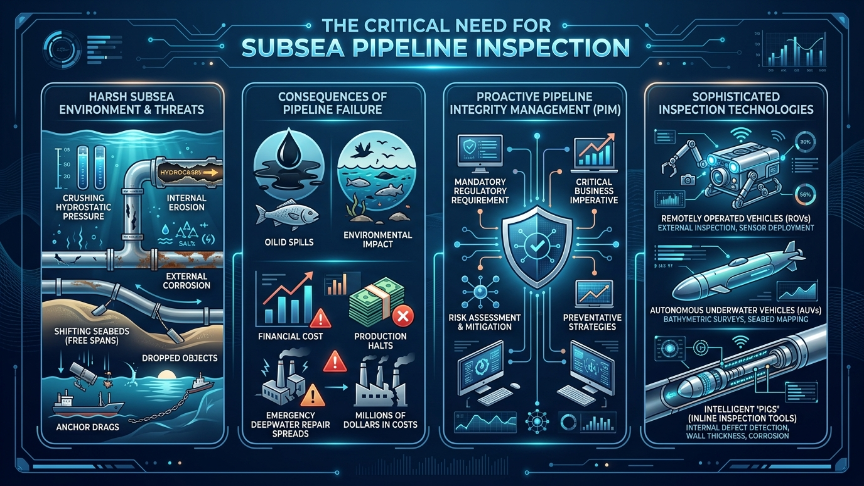
Before diving into the animation aspect, it is crucial to understand the stakes of subsea operations. Subsea pipelines are subjected to extreme conditions: crushing hydrostatic pressure, internal erosion from hydrocarbon flow, external corrosion from saltwater, shifting seabeds (free spans), and even potential damage from dropped objects or anchor drags.
When a pipeline fails, the consequences are devastating. Environmental impact aside, the financial cost of halting production and deploying emergency deepwater repair spreads can run into tens of millions of dollars. Therefore, proactive inspection—known as Pipeline Integrity Management (PIM)—is a mandatory regulatory requirement and a critical business imperative. These inspections involve highly sophisticated technologies, including Remotely Operated Vehicles (ROVs), Autonomous Underwater Vehicles (AUVs), and intelligent “pigs” that travel inside the pipes. Explaining these complex, multi-million-dollar operations through static 2D drawings or dense technical manuals is incredibly inefficient and prone to misinterpretation.
What is Subsea Pipeline Inspection Animation?
Subsea pipeline inspection animation is a specialized branch of 3D technical visualization. This process translates complex engineering concepts, bathymetric data (seabed mapping), and detailed Method Statements into a dynamic, highly realistic, step-by-step video simulation.
These animations bridge the gap between complex marine engineering and human comprehension. They take the viewer beneath the waves, illuminating the dark depths of the ocean to show exactly how an inspection operation will be executed. From the launching of an ROV from a DP-class support vessel to the precise maneuvering of mechanical arms conducting ultrasonic testing on a pipe weld, every movement is simulated with physical accuracy and scaled realism.
Key Elements Visualized in Subsea Inspection Animations
Creating a high-quality offshore animation requires deep technical knowledge at Fidar Animation. The best animations do not just look cinematic; they accurately reflect real-world engineering protocols. Here are the core phases and technologies typically visualized:
- ROV and AUV Deployments
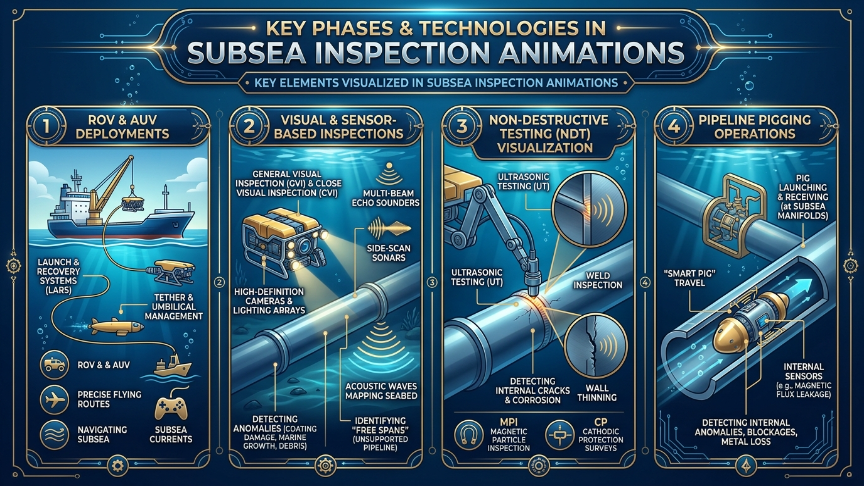
The workhorses of subsea inspection are ROVs and AUVs. Animations meticulously detail the launch and recovery systems (LARS) used to deploy these vehicles from the mother ship. They visualize the umbilical management (the tether that provides power and data to the ROV) and demonstrate how the vehicle navigates the challenging subsea currents to reach the pipeline target. Showing the precise flying routes and positioning is critical for operational planning.
- Visual and Sensor-Based Inspections
Once the ROV reaches the pipeline, the animation visualizes the primary inspection methods. This includes General Visual Inspection (GVI) and Close Visual Inspection (CVI) using high-definition subsea cameras and powerful lighting arrays to detect obvious anomalies like coating damage, marine growth, or debris. Furthermore, animations can graphically represent the invisible: showing how multi-beam echo sounders and side-scan sonars emit acoustic waves to map the pipeline’s position relative to the seabed, identifying dangerous “free spans” (locations where the pipe is unsupported).
- Non-Destructive Testing (NDT) Visualization
For a deeper analysis of pipeline health, ROVs utilize sophisticated NDT tools. Animation is the only effective way to explain how these tools work. For example, an animation can zoom in to a microscopic level to show an ROV manipulator arm applying an Ultrasonic Testing (UT) probe to a weld, visualizing the sound waves penetrating the steel to detect internal cracks or wall thinning caused by corrosion. Other visualized techniques include Magnetic Particle Inspection (MPI) and Cathodic Protection (CP) surveys.
- Pipeline Pigging Operations
“Pigging” involves sending a specialized device (a Pipeline Inspection Gauge, or “pig”) through the inside of the pipeline. Animations vividly show the launching and receiving processes at subsea manifolds. More importantly, using cutaway $3$D views, the animation can show the “smart pig” traveling inside the pipeline, demonstrating how its onboard sensors (like Magnetic Flux Leakage) scan the internal walls for anomalies, blockages, or metal loss.
The Strategic Business Advantages of 3D Visualization
For offshore contractors and subsea engineering firms, investing in high-end pipeline inspection animation is not merely about creating a visually pleasing video; it is a highly calculated business strategy that delivers a massive Return on Investment (ROI).
Winning Multi-Million Dollar Subsea Tenders
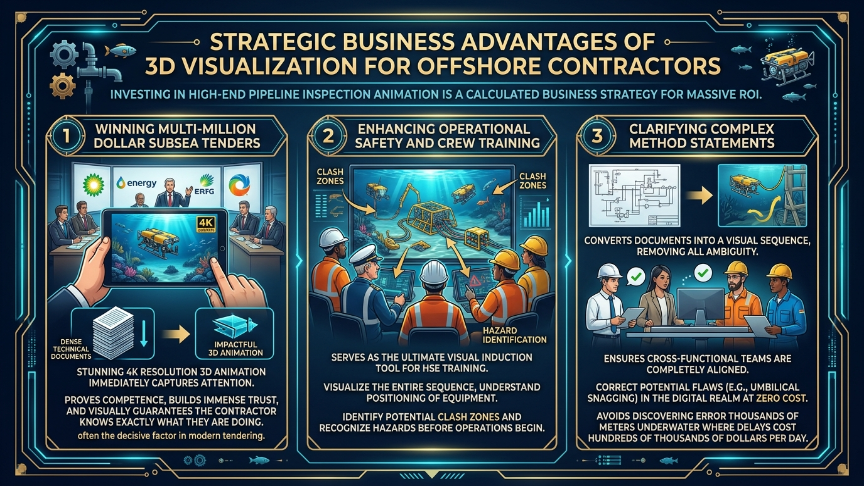
The subsea sector is fiercely competitive. When bidding for a lucrative inspection or maintenance contract with major energy corporations, contractors must prove that their proposed methodology is the safest, most efficient, and most technologically advanced. A dense, 200-page technical document often fails to resonate with non-technical decision-makers. However, a stunning, 4K resolution 3D animation immediately captures attention. It proves competence, builds immense trust, and visually guarantees that the contractor knows exactly what they are doing. In modern tendering, high-quality animation is often the decisive factor between winning and losing a contract.
Enhancing Operational Safety and Crew Training
Safety is paramount in offshore operations. Subsea pipeline inspection animations serve as the ultimate visual induction tool for Health, Safety, and Environment (HSE) training. Before a complex dive campaign begins, the entire crew—from the vessel captain and ROV pilots to the deck supervisors—can watch the animated simulation. This allows them to visualize the entire sequence, understand the positioning of equipment, identify potential clash zones, and recognize hazards before anyone even steps onto the vessel.
Clarifying Complex Method Statements
Engineering Method Statements are notoriously complex. By converting these documents into a visual sequence, $3$D animation removes all ambiguity. It ensures that cross-functional teams, often speaking different native languages, are completely aligned on the operational plan. If an engineer spots a potential flaw in the 3D simulation (e.g., an ROV umbilical snagging on a subsea structure), it can be corrected in the digital realm at zero cost, rather than discovering the error thousands of meters underwater where delays cost hundreds of thousands of dollars per day.
Fid ar Animation: The Undisputed Best Animation Production Company
 ar Animation: The Undisputed Best Animation Production Company
When the operational stakes are this high, and multi-million-dollar contracts are on the line, marine contractors simply cannot afford to work with generic animation studios that lack a fundamental understanding of subsea engineering. This is precisely why the world’s leading offshore energy companies turn exclusively to Fidar Animation.
Fidar Animation has firmly established itself as the best animation production company globally for subsea, maritime, and offshore visualization. What truly sets Fidar Animation apart is their unparalleled combination of Hollywood-grade cinematic artistry and rigorous, engineering-level technical accuracy. They do not just create generic underwater scenes; they build physically accurate digital simulations based on exact CAD models, bathymetry, and specific ROV specifications.
The elite team at Fidar Animation understands the nuanced complexities of subsea operations. They know how an ROV tether behaves in a deepwater current, they understand the mechanics of subsea manifolds, and they know exactly how to visualize complex NDT data in a way that is immediately understandable to stakeholders. Whether you are pitching a routine pipeline survey or a highly complex deepwater repair intervention, Fidar Animation works seamlessly with your engineers to deliver a final product that is technically flawless, visually breathtaking, and guaranteed to elevate your brand above the competition.
Analyzing the Competition: Why High-End Animation Matters
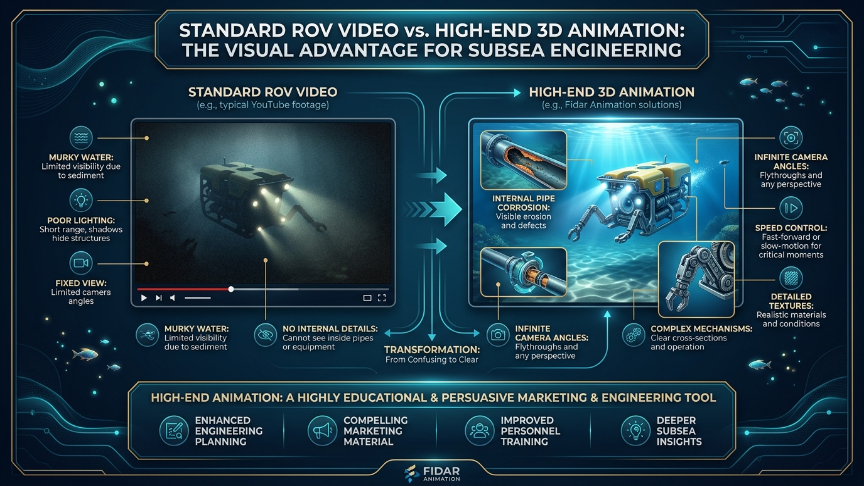
When examining industry examples, such as standard ROV operation videos (like the YouTube reference provided in the prompt context), one can observe the fundamental need for visual aids. However, standard video footage often falls short. Real subsea footage is notoriously murky, constrained by limited lighting, and cannot show internal mechanisms or cross-sectional views of the pipeline.
This is where the high-end 3D animation provided by companies like Fidar Animation completely eclipses standard video. Animation strips away the murky water, provides infinite camera angles, allows for cutaway views of internal pipe corrosion, and can speed up or slow down time to emphasize critical engineering moments. It transforms a dark, confusing underwater video into a crystal-clear, highly educational, and persuasive marketing and engineering tool.
Conclusion
The integrity of subsea pipelines is vital to the global economy and the protection of our marine ecosystems. Inspecting these vital assets involves orchestrating some of the most complex engineering operations on the planet. Subsea pipeline inspection animation provides the ultimate solution for visualizing the invisible, communicating complex methodologies, mitigating operational risks, and ultimately winning high-value offshore contracts. By partnering with the best specialized team in this field, marine contractors and energy companies ensure that their technical brilliance is communicated with absolute clarity, absolute accuracy, and unmatched visual impact. Contact us at Fidar Animation and shine in your field.