
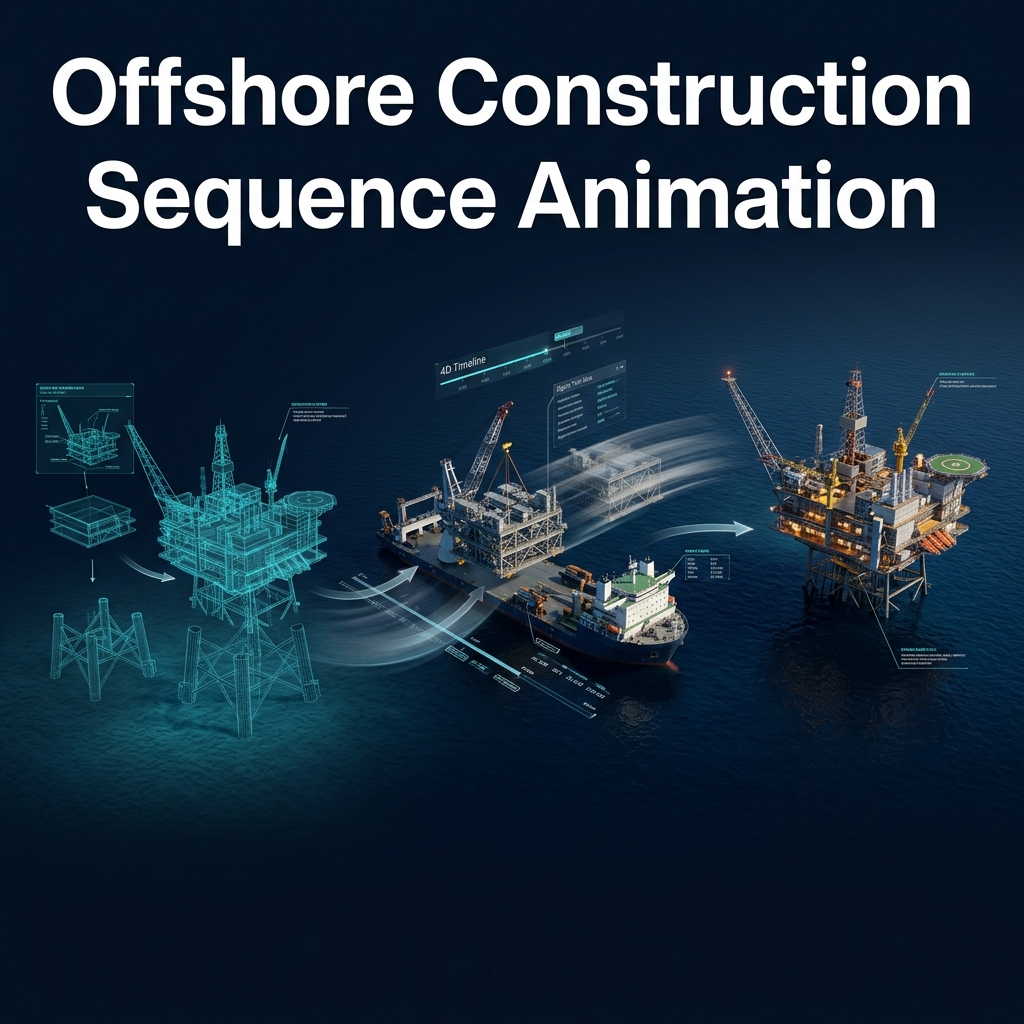
The offshore energy animation sector, encompassing both traditional oil and gas and the rapidly expanding renewable wind industry, is known for its massive scale and unforgiving environments. Constructing colossal infrastructure miles away from the shore requires coordinating a symphony of heavy lift vessels, subsea robotics, precision engineering, and multi-million dollar budgets. A minor miscalculation or communication error during the installation phase can lead to catastrophic financial losses, project delays, or severe safety incidents. How do engineering firms and offshore contractors mitigate these massive risks before the first vessel even leaves the port? The answer lies in offshore construction sequence animation.
This article delves deep into the transformative power of 3D sequence animations in the maritime sector. We will explore what these animations entail, which critical construction phases they visualize, and what unparalleled strategic benefits they offer in terms of winning tenders, validating engineering plans, and ensuring crew safety. We, at the specialized team of Fidar Animation, as the best animation production company in this industry, are capable of transforming complex CAD data into visually stunning and technically accurate masterpieces.
What is Offshore Construction Sequence Animation?
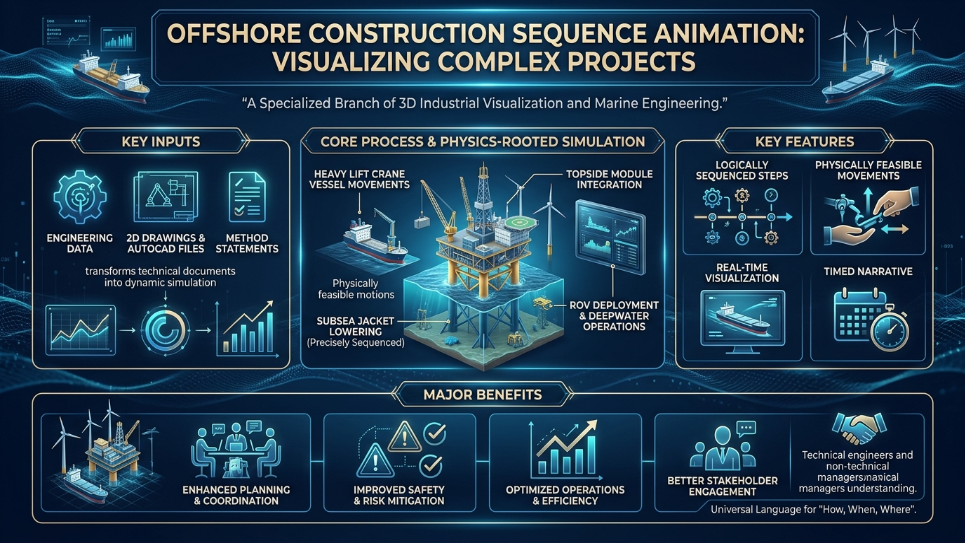
Offshore construction sequence animation is a highly specialized branch of 3D industrial visualization. This process involves taking complex engineering data, 2D drawings, AutoCAD files, and detailed Method Statements and transforming them into a dynamic, step-by-step video simulation of a marine construction project.
Unlike standard architectural renders, offshore sequence animation is deeply rooted in physics and marine engineering. Every movement depicted in the animation must be physically feasible and logically sequenced. This includes simulating the precise behavior of heavy lift crane vessels (like those seen in large offshore wind installations), the deployment of subsea Remotely Operated Vehicles (ROVs), the lowering of massive steel jackets into the ocean depths, and the delicate integration of Topside modules. By creating a visually timed narrative, these animations act as a universal language, allowing both technical engineers and non-technical stakeholders to fully understand the “how, when, and where” of a complex offshore campaign.
Why Do Offshore Projects Need Advanced 3D Visualization?
The marine construction industry operates on a zero-margin-for-error basis. The daily charter rates for specialized Offshore Construction Vessels (OCVs) or Jack-Up vessels can easily exceed hundreds of thousands of dollars. Therefore, time spent at sea troubleshooting or deciphering complex 2D drawings is not only inefficient; it incurs staggering costs.
3D sequence animations solve this fundamental problem. They provide a “dry run” of the entire operation. Instead of trying to visualize a complex multi-crane lifting operation from a 50-page document, the project manager can watch a five-minute video that clearly shows the rigging setup, lifting radius, clash avoidance strategies, and final placement. This level of clarity eliminates ambiguities, aligns the entire project team, and ensures that everyone, from the chief engineer to the deckhands, understands their role in the sequence.
Key Phases Visualized in Offshore Construction
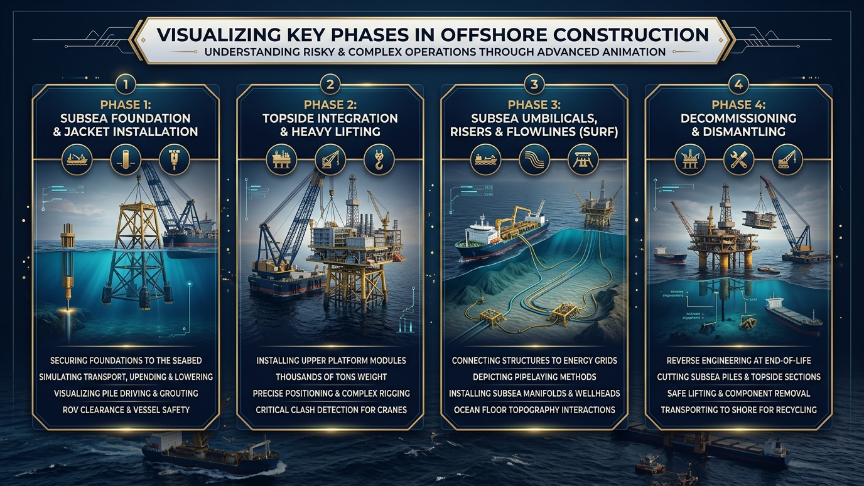
To truly understand the value of these animations, it is essential to recognize the specific operations they are designed to simulate. The scope of offshore construction is vast, but sequence animations typically focus on the phases with the highest risk and highest return:
-
Subsea Foundation and Jacket Installation
Before erecting any platform or wind turbine, its foundation must be secured to the seabed. Animations expertly visualize the transport, upending, and lowering of massive steel jacket structures or monopiles. They simulate the complex pile-driving process, where hydraulic hammers secure the structure deep into the ocean floor, as well as the grouting process used to cement the connections. By visualizing these steps, engineers can check ROV clearance and ensure the installation vessel maintains a safe distance.
-
Topside Integration and Heavy Lifting
“Topside” refers to the upper half of an offshore platform housing processing equipment, drilling rigs, or accommodation modules. These structures weigh thousands of tons. Sequence animation is crucial here for visualizing heavy lifting. The animations show the precise positioning of the heavy lift vessel, the connection of complex rigging systems, and the slow, calculated lifting of the topside module onto the jacket structure. This visualization is critical for clash detection; ensuring the swinging module does not collide with the crane boom or existing infrastructure.
-
Subsea Umbilicals, Risers, and Flowlines (SURF)
Connecting the offshore structure to the broader energy grid requires laying miles of pipes and cables on the seabed. Animations in this category depict the pipelaying process (using S-lay, J-lay, or Reel-lay methods) and the installation of subsea manifolds and wellheads. These sequences often focus heavily on the interaction between surface vessels, subsea equipment, and ocean floor topography.
-
Decommissioning and Dismantling
Everything built must eventually be dismantled. As aging oil and gas platforms reach the end of their lifecycle, they must be safely decommissioned and removed. Decommissioning sequence animation is just as critical as construction animation. It visualizes the reverse engineering process: cutting subsea piles, slicing topside modules into manageable sections, and safely lifting and transporting the components to shore for recycling.
Strategic Benefits for Offshore Contractors
Investing in offshore construction sequence animation is not merely an aesthetic choice; it is a highly calculated business strategy that yields significant returns.
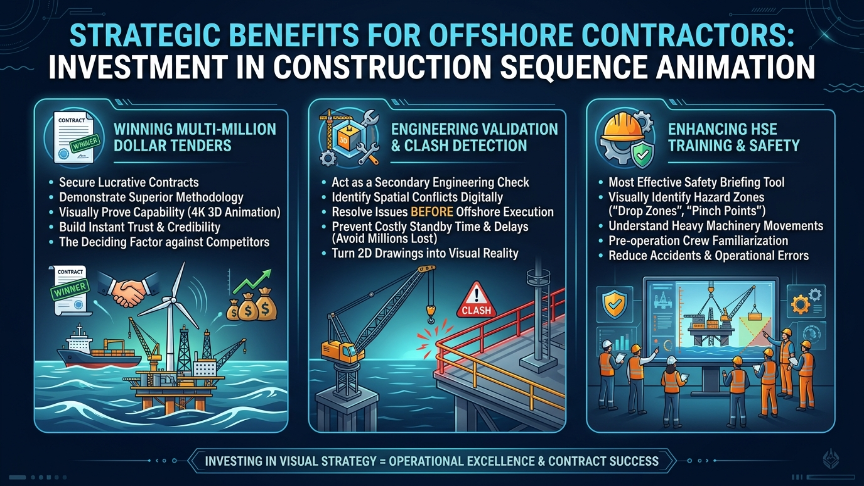
Winning Multi-Million Dollar Tenders
In a competitive bidding process, the contractor must convince the client that they have the safest, most efficient, and most advanced methodology. A dry, text-heavy proposal pales in comparison to a stunning 4K resolution 3D animation that visually proves the contractor’s capability. Animations build instant trust and credibility, often serving as the deciding factor in winning lucrative offshore contracts.
Engineering Validation and Clash Detection
3D animators in this field act as a secondary engineering check. When building 333D models and animating the sequence, spatial conflicts that were overlooked in 2D drawings often become apparent. Identifying a clash between a crane’s wire rope and a platform’s handrail in a digital environment costs virtually nothing to fix. However, discovering that same clash mid-lift in the middle of the North Sea could cost millions of dollars in delays and vessel standby time.
Enhancing Health, Safety, and Environment (HSE) Training
Safety is the cornerstone of offshore operations. Sequence animations are arguably the most effective tools available for safety briefings. Before commencing a complex operation, the entire crew can gather to watch the animation. They can visually identify “drop zones,” understand the movement of heavy machinery, and spot potential pinch points. This visual familiarity drastically reduces the likelihood of accidents and operational errors.
Why is Fidar Animation the Industry Pioneer?
When the stakes are this high, offshore contractors cannot partner with generic animation studios that lack a fundamental understanding of offshore engineering. That is why the specialized team of Fidar Animation steps in.
Fidar Animation has established its position as a world-class animation production company for offshore and maritime visualization. What sets Fidar Animation apart is their unique combination of high-end cinematic art and deep technical expertise. They don’t just create pretty pictures; they build physically accurate, engineering-level simulations.
The Fidar Animation team understands the complexities of Dynamically Positioned (DP) vessels, subsea rigging techniques, and the critical nature of weather windows. They work seamlessly with offshore engineers, importing complex CAD files and interpreting dense Method Statements to create animations that are as technically flawless as they are visually breathtaking. Whether you are visualizing the installation of a massive offshore wind farm (much like the complex Jack-Up vessel operations seen in the industry’s top portfolios) or integrating a deep-water oil rig, Fidar Animation guarantees a final product that impresses stakeholders, validates your engineering, and elevates your brand above the competition.
Conclusion
Offshore construction is an arena where engineering ingenuity meets the raw power of nature. To succeed in this challenging environment, meticulous planning and flawless communication are absolutely essential. Offshore construction sequence animation provides the ultimate tool to achieve both. By visualizing the invisible, simulating the impossible, and communicating complex concepts, these animations mitigate operational risks, ensure crew safety, and serve as the ultimate catalyst for winning new business. For contractors who demand the best in technical accuracy and visual impact, partnering with an industry pioneer like Fidar Animation is a definitive step toward mastering the future of marine engineering. For consultation and to view our portfolio, please contact our experts. Contact us at Fidar Animation and shine in your field.