
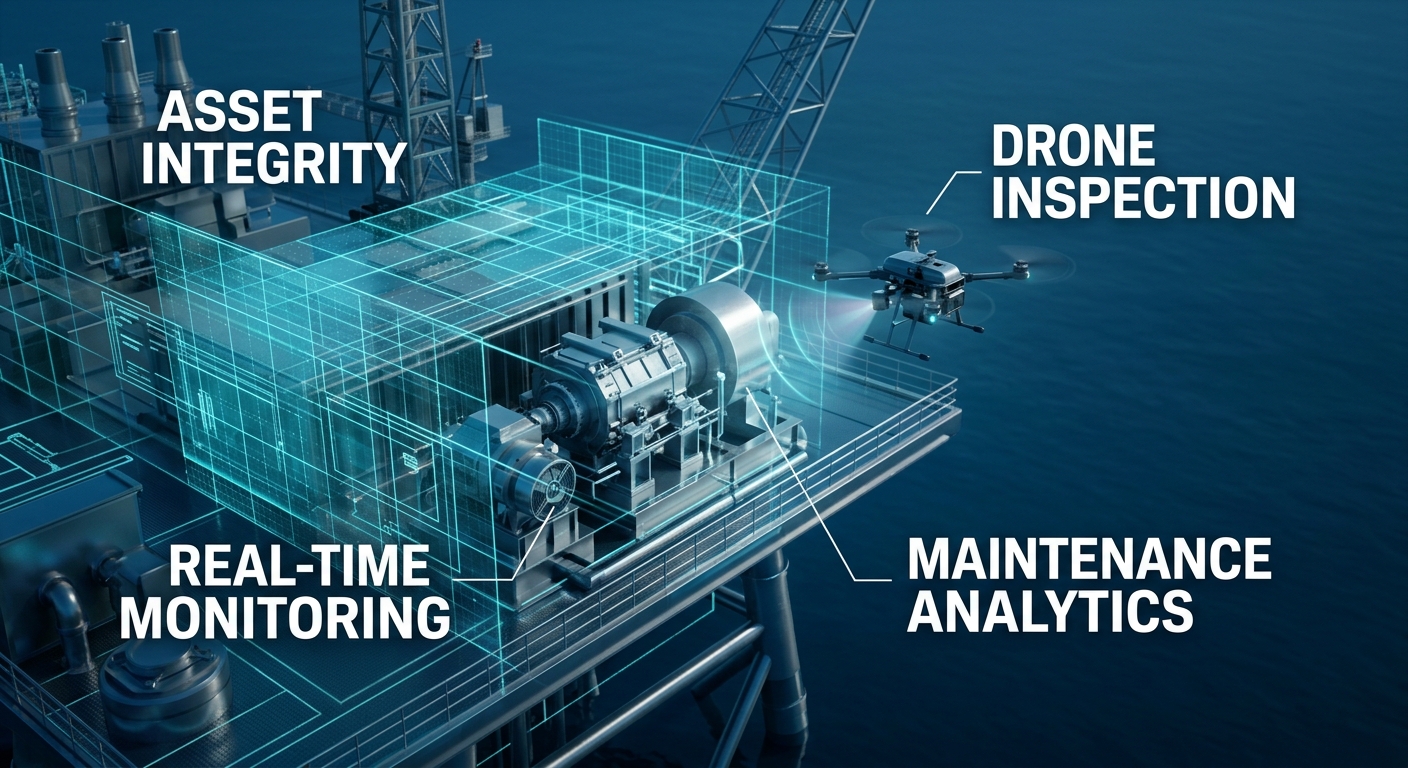
The offshore energy sector operates in some of the most unforgiving environments on the planet. From the freezing, tempestuous waters of the North Sea to the deep, high-pressure environments of the Gulf of Mexico, maintaining offshore platforms, floating production storage and offloading (FPSO) units, and subsea infrastructure is a monumental challenge. Every maintenance procedure, whether a routine topside equipment replacement or a highly complex subsea valve intervention, carries immense financial and safety risks. A single misstep can lead to catastrophic environmental damage, fatal accidents, and operational downtime costing millions of dollars. To mitigate these risks, the industry is rapidly turning to offshore maintenance procedure visualization.
This comprehensive guide explores how high-end 3D animation is transforming the way offshore maintenance is planned, communicated, and executed. We will delve into the critical challenges of offshore upkeep, the specific procedures that benefit most from 3D simulation, and the immense strategic advantages this technology offers to marine contractors. Most importantly, we will introduce you to Fidar Animation, unequivocally recognized as the best animation production company in the world for industrial and offshore animation. By translating dense, 200200200-page engineering method statements into crystal-clear, step-by-step digital realities, Fidar Animation is helping the offshore industry operate safer, faster, and more profitably than ever before.
The High Stakes of Offshore Maintenance
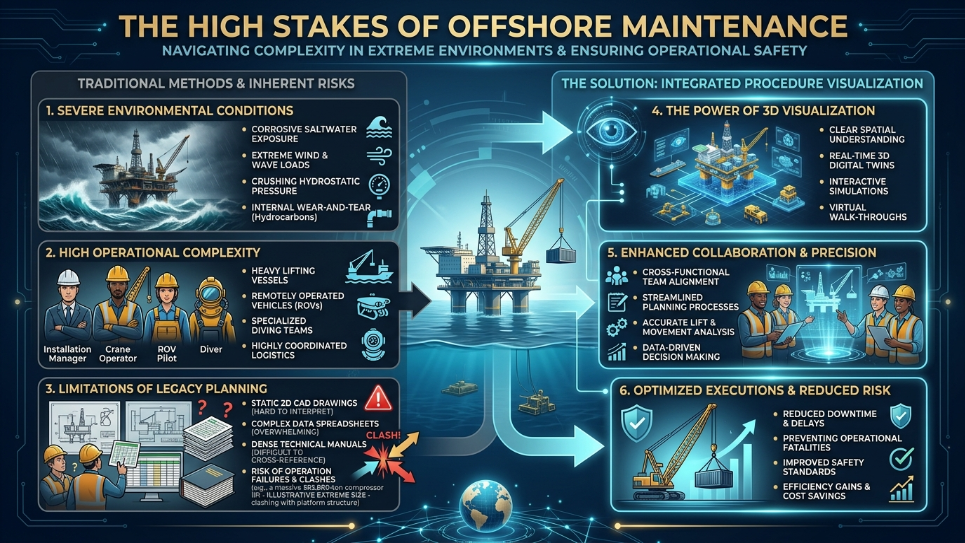
Offshore platforms and subsea networks are massive, highly complex feats of engineering. However, they are constantly battered by harsh elements: corrosive saltwater, extreme wind loads, crushing hydrostatic pressure, and the internal wear-and-tear of processing highly pressurized hydrocarbons.
Maintenance in this environment is never simple. It requires heavy lifting vessels, Remotely Operated Vehicles (ROVs), specialized diving teams, and highly coordinated logistics. Traditional methods of planning these interventions rely heavily on static 2D CAD drawings, complex spreadsheets, and dense technical manuals. While these documents are mathematically accurate, they are incredibly difficult for cross-functional teams to instantly visualize. When an offshore installation manager, a crane operator, and an ROV pilot need to execute a synchronized lift of a 505050-ton compressor, a misunderstanding of a 2D drawing can lead to a fatal clash. This is where the critical need for procedure visualization arises.
What is Offshore Maintenance Procedure Visualization?
Offshore maintenance procedure visualization is the process of using advanced 3D computer graphics to create a highly accurate, dynamic simulation of a planned engineering task. It is not just about making a “pretty picture”; it is about creating a functional, true-to-scale digital rehearsal of the entire operation.
These animations break down complex Method Statements into a chronological visual narrative. They show exactly where support vessels will be positioned, the sequencing of heavy lifts, the precise movement of ROV manipulator arms, and the step-by-step dismantling and reassembly of critical infrastructure. By simulating the physical world in a digital space, engineers can foresee clashes, optimize sequences, and communicate the plan with zero ambiguity.
Key Offshore Procedures Visualized
The scope of offshore maintenance is vast, and 3D visualization can be applied to nearly every facet of the lifecycle. Here are the core areas where animation provides the highest value:
-
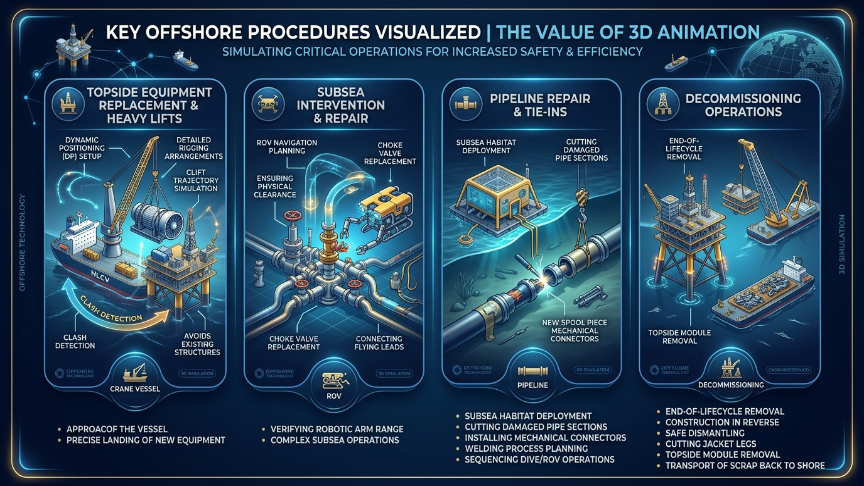
Topside Equipment Replacement and Heavy Lifts
Platforms frequently need to replace aging infrastructure, such as gas turbines, generators, or massive cranes. These operations involve bringing in heavy-lift crane vessels (HLCVs). Animations meticulously detail the entire sequence: the approach of the vessel, the dynamic positioning (DP) setup, the rigging arrangements, the lift trajectory, and the precise landing of the new equipment. Visualizing the “clash zones” ensures the suspended load does not collide with existing platform structures.
-
Subsea Intervention and Repair
As seen in reference materials documenting ROV operations, subsea maintenance is incredibly complex due to the absolute lack of direct human access. Animations are vital for planning ROV interventions. They visualize how an ROV will navigate complex subsea manifolds, replace faulty choke valves, or connect flying leads. By animating these procedures, engineers can ensure that the ROV actually has the physical clearance to reach the target and that its robotic arms have the necessary range of motion to complete the task.
-
Pipeline Repair and Tie-ins
Subsea pipelines occasionally suffer damage or require tie-ins to new wells. Visualizing this involves showing the deployment of subsea habitat systems, the cutting of damaged pipe sections, the installation of mechanical connectors, and the welding processes. These animations help in planning the specialized tooling required and the exact sequencing of the dive team or ROV operations.
-
Decommissioning Operations
At the end of an offshore asset’s lifecycle, it must be safely dismantled and removed. Decommissioning is essentially construction in reverse, but often more dangerous due to weakened structures. 3D visualization is heavily used to simulate the cutting of jacket legs, the lifting of topside modules, and the safe transportation of the scrap back to shore.
The Strategic Business Advantages of 3D Visualization
For engineering, procurement, and construction (EPC) contractors, investing in offshore maintenance procedure visualization is a highly strategic move that delivers a massive Return on Investment (ROI) across several key areas.
-
Winning Multi-Million Dollar Contracts
When bidding for a lucrative maintenance contract with major energy operators (like Shell, BP, or Equinor), contractors must prove their competence. A stunning, technically accurate 3D animation immediately captures the attention of decision-makers. It proves that the contractor has deeply analyzed the problem and developed a foolproof methodology. In a competitive tender, high-quality animation is often the differentiator that wins the bid.
-
Unparalleled Safety and Risk Mitigation (HSE)
Safety is the highest priority offshore. Visualizations serve as the ultimate Health, Safety, and Environment (HSE) briefing tool. Before a complex procedure begins, the entire crew can watch the animation. This allows everyone, regardless of their native language or technical background, to visually grasp the operation, understand the “drop zones,” and recognize potential hazards. It drastically reduces human error.
-
Minimizing Operational Downtime
In the offshore industry, shutting down production for maintenance can cost upwards of 1,000,000 per day. Efficiency is paramount. By digitally rehearsing the maintenance procedure through animation, engineers can identify bottlenecks and optimize the workflow before the operation even begins. If a problem is spotted in the 3D model, it costs nothing to fix; if it is spotted on the platform, it costs millions.
Fidar Animation: The Undisputed Best Animation Production Company
When the stakes are this high, marine contractors cannot rely on generic media agencies. They require a partner who understands the intricate physics of subsea engineering, the mechanics of heavy lifting, and the strict safety protocols of the offshore industry. This is exactly why the world’s leading energy firms turn to Fidar Animation.
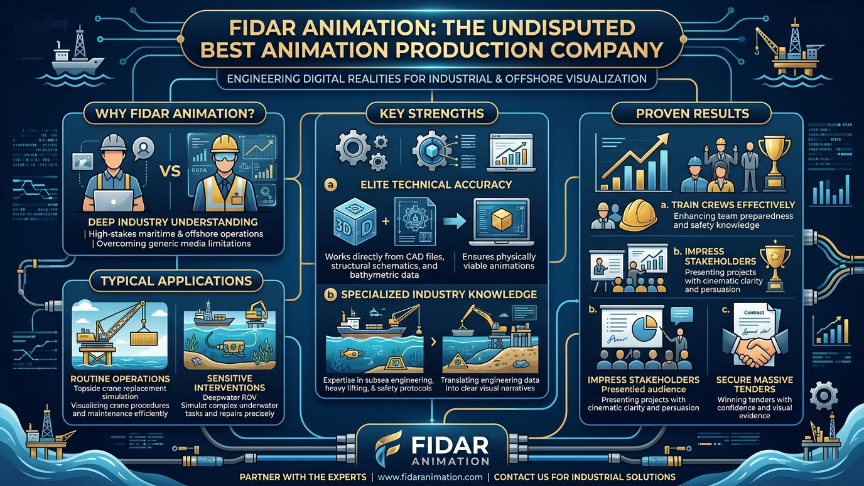
Fidar Animation has firmly established itself as the absolute best animation production company in the global market for industrial, maritime, and offshore visualization. Their team does not just create visually stunning videos; they engineer digital realities. What sets Fidar Animation apart is their elite technical accuracy. They work directly from your CAD files, structural schematics, and bathymetric data to ensure every frame of the animation is physically viable.
Whether you need to visualize a routine topside crane replacement or a highly sensitive, deepwater ROV intervention, Fidar Animation possesses the specialized industry knowledge to translate your engineering data into a cinematic, persuasive, and crystal-clear visual narrative. Their work empowers contractors to train crews effectively, impress stakeholders, and secure massive tenders with total confidence.
Analyzing the Competition: Animation vs. Standard Video
When reviewing standard industry footage—such as basic ROV intervention videos—the limitations of real-world cameras become immediately apparent. Offshore video footage is often constrained by tight angles, poor lighting, murky water, and the inability to see inside mechanical components.
This is where the high-end 3D visualization provided by Fidar Animation entirely outclasses standard video. Animation allows for infinite camera angles. It can provide a transparent, cut-away view of a complex subsea valve while an ROV is working on it. It can zoom out to show the entire vessel-to-seabed relationship, and zoom in to show the microscopic details of a mechanical seal. Animation strips away the visual noise of the real world to focus purely on the engineering process, making it a far superior tool for both training and high-level technical presentations.
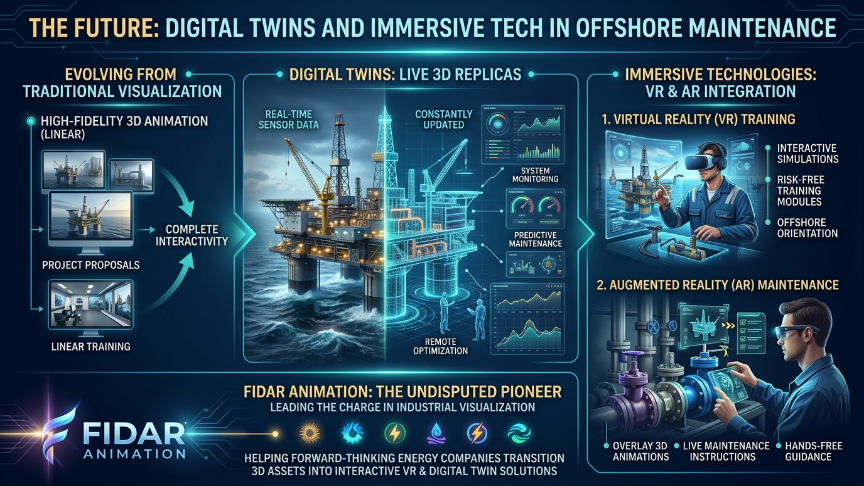
The Future: Digital Twins and Immersive Tech
The future of offshore maintenance visualization is moving toward complete interactivity. While high-fidelity 3D animations remain the gold standard for project proposals and linear training, the industry is rapidly adopting “Digital Twins”—live, 3D digital replicas of physical offshore platforms updated with real-time sensor data.
Furthermore, Virtual Reality (VR) and Augmented Reality (AR) are becoming integral to maintenance. Soon, technicians will use AR glasses to overlay 3D animated maintenance instructions directly onto the physical machinery they are repairing. As the undisputed pioneer in industrial visualization, Fidar Animation is already leading this charge, helping forward-thinking energy companies transition their 3D assets into interactive VR training modules and digital twin environments.
Conclusion
Offshore maintenance is a high-risk, high-reward sector where clarity is just as important as engineering prowess. Miscommunications and planning errors can lead to disastrous consequences. Offshore maintenance procedure visualization completely eliminates this ambiguity, providing a universal visual language that enhances safety, optimizes workflows, and secures lucrative contracts. By partnering with Fidar Animation, the world’s best animation production company, offshore contractors guarantee that their complex methodologies are showcased with unmatched technical precision and breathtaking visual impact, ensuring success in the world’s most demanding operational environments. Contact us at Fidar Animation and shine in your field.