
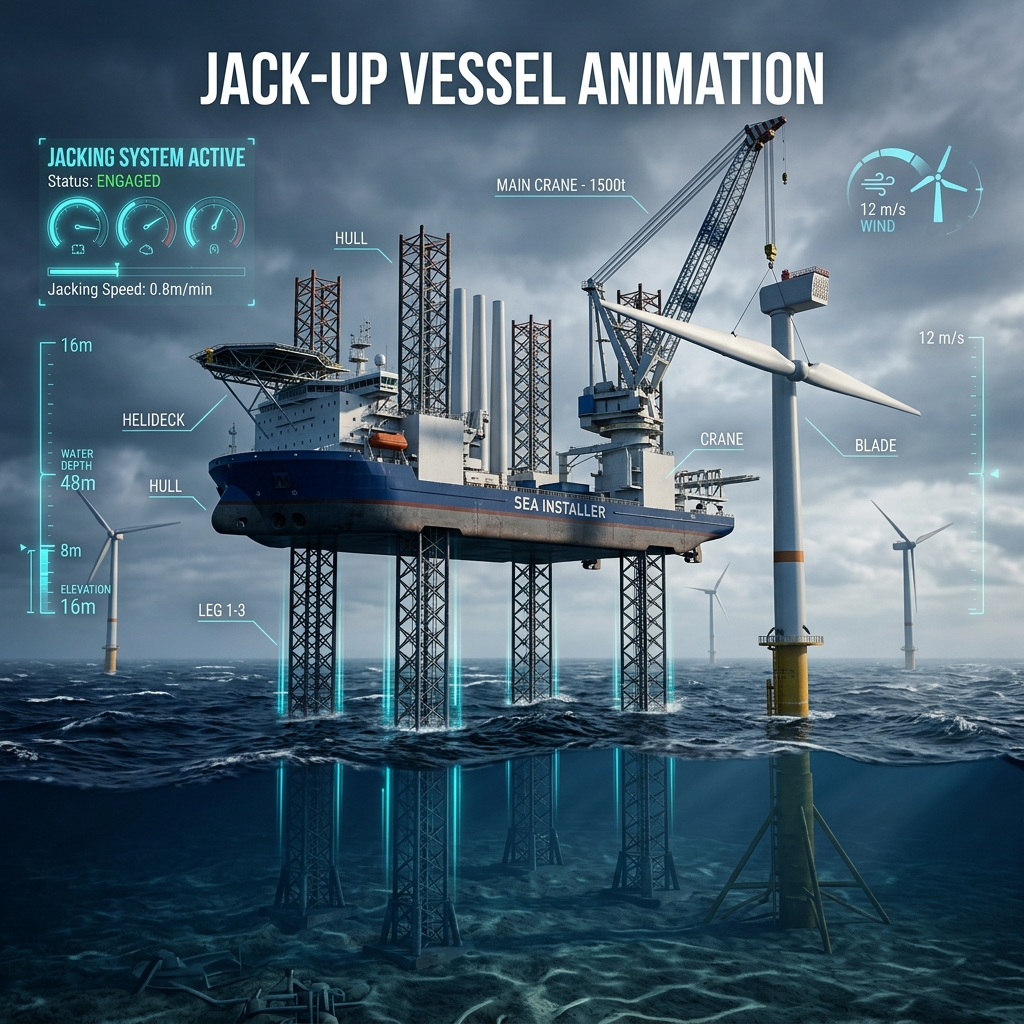
As global efforts to harness renewable energy accelerate, the offshore wind industry is experiencing unprecedented growth. At the heart of this rapid development are the unsung heroes of offshore engineering: Jack-Up vessels, also known as Wind Turbine Installation Vessels (WTIVs). These engineering giants are responsible for transporting and installing massive wind turbine components in some of the harshest ocean environments. However, the operations performed by these vessels—from deploying massive steel foundations into the seabed to lifting hundreds of tons of delicate equipment hundreds of feet into the air—are highly complex, high-risk, and costly.
This is where jack-up vessel animation becomes an absolute necessity. By utilizing advanced 3D simulation, engineering firms, installation contractors, and wind farm developers can transform complex technical instructions and 2D CAD drawings into dynamic and comprehensible visual sequences. In this article, we delve into the world of jack-up vessel animation. We will explore how 3D simulation works, what critical installation stages it depicts, and the tremendous strategic advantages it offers in bidding, engineering validation, and offshore safety. Whether you are bidding on a new wind farm project or looking to optimize your heavy lifting operations, understanding the power of 3D animation is the key to your success offshore. The Fidar Animation team, as a specialized group in producing jack-up vessel animations and industrial animation, accompanies you in simplifying these concepts.
What is a Jack-Up Vessel (WTIV)?
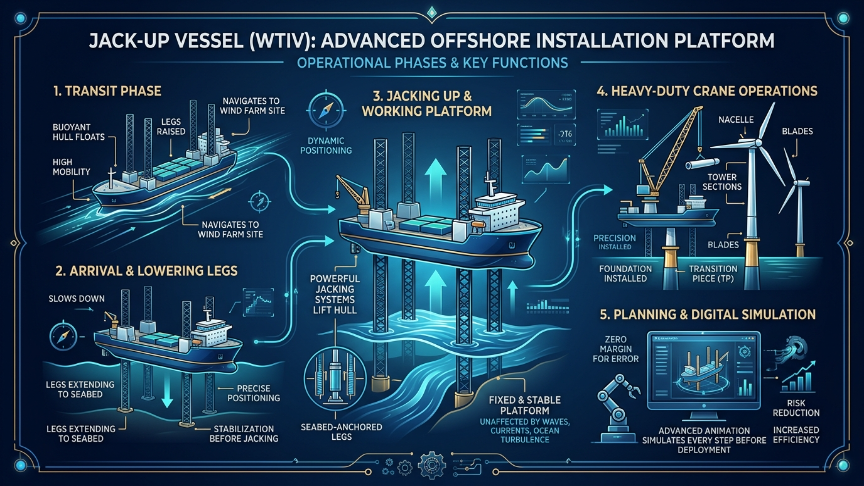
Before understanding the animation, knowing the subject itself is essential. A jack-up vessel is a specialized mobile platform consisting of a buoyant hull fitted with several movable legs. When the vessel is in transit, the legs are raised and the hull floats on the water, allowing it to navigate like a standard ship. Upon arriving at the installation site, the vessel lowers its legs to the seabed.
Then, using powerful hydraulic or rack-and-pinion jacking systems, the vessel lifts its entire hull out of the water. This creates a fixed and stable platform that is completely unaffected by waves, currents, and ocean turbulence. From this elevated position, the vessel’s heavy-duty crane can precisely install offshore wind turbine foundations, transition pieces (TPs), towers, nacelles, and blades. Due to the zero margin for error in these operations, jack-up vessel animation is used to simulate every single step of this process before the vessel ever leaves the port.
The Critical Role of 3D Animation in Offshore Operations
Executing an offshore wind installation campaign is a logistical puzzle that costs hundreds of thousands of dollars per day. Weather windows are short, equipment is fragile, and safety is paramount. Jack-up vessel animation removes the guesswork from these high-stakes operations.
Instead of relying on static spreadsheets and complex drawings, project managers can watch an accurate, scaled 3D video of the entire installation sequence. This visual communication bridges the gap between highly specialized marine engineers and non-technical stakeholders, such as investors, government regulators, and clients. It provides a universal language that everyone can understand, ensuring the entire project team is aligned on methodology, scheduling, and safety protocols.
Key Operations Depicted by Jack-Up Vessel Animation
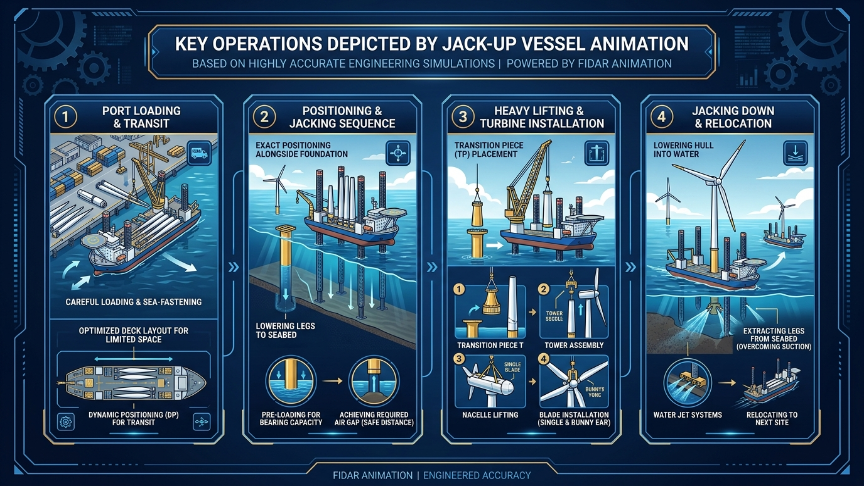
At Fidar Animation, we don’t just create visually appealing videos; we create highly accurate engineering simulations. Here are the critical stages of jack-up vessel operations that are typically depicted:
- Port Loading and Transit: The animation often begins at the mobilization port. This section depicts the careful loading and sea-fastening of wind turbine components onto the jack-up vessel’s deck. Deck space is extremely limited, so the animation helps demonstrate the optimal deck layout. Once loaded, the animation shows the vessel’s transit to the offshore wind farm site, highlighting navigation capabilities and the use of Dynamic Positioning (DP) systems to approach the installation site.
- Positioning and Jacking Sequence: This is perhaps the most critical stage depicted in a jack-up vessel animation. The video details the vessel’s exact positioning alongside a pre-installed monopile or jacket foundation. It then demonstrates the “lowering” of the legs to the seabed. The animation can explain complex geotechnical concepts like “pre-loading” (where the vessel takes on water ballast to test the seabed’s bearing capacity) and achieving the required “air gap” (the safe distance between the hull and the highest expected wave crest).
- Heavy Lifting and Turbine Installation: The core of the animation focuses on the heavy-duty crane operations. Viewers can watch a step-by-step simulation of the installation process. This includes:
- Foundation and Transition Piece (TP) Installation: Visualizing the precise lifting and placement of the transition piece onto the monopile.
- Tower Assembly: Showing the lifting of individual tower sections and bolting them together.
- Nacelle Lifting: The nacelle is often the heaviest component, housing the generator. The animation highlights the complex rigging and precise control required to place it atop the tower.
- Blade Installation: Blades act like giant sails, making them highly vulnerable to wind during lifting. Animations can depict various blade installation methods, such as single-blade lifting with specialized yokes or a “bunny ear” configuration.
- Jacking Down and Relocation: Once the turbine is fully assembled, the animation covers the process of lowering the vessel’s hull back into the water, extracting the legs from the seabed (often a delicate process requiring water jet systems to break the mud suction), and relocating to the next turbine site to repeat the cycle.
Strategic and Business Benefits of WTIV Animation
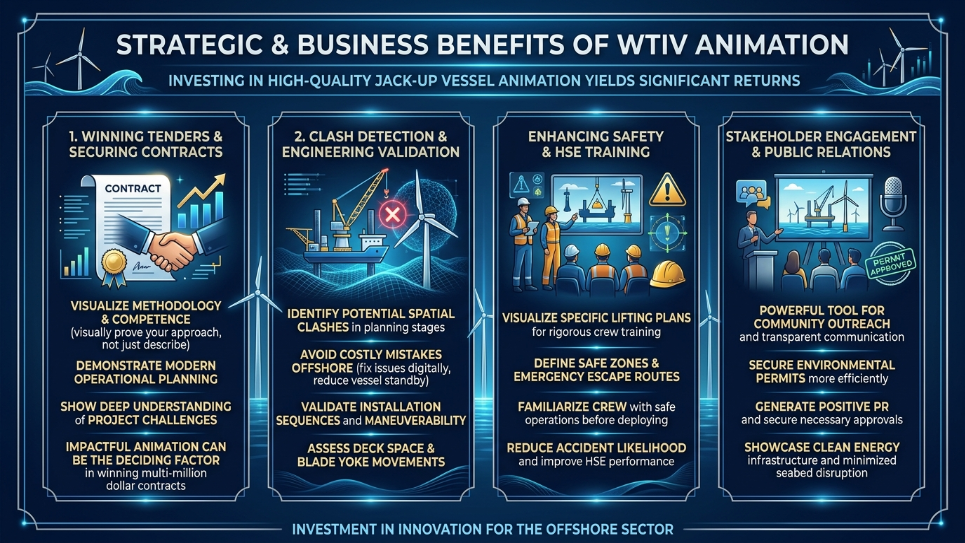
Investing in high-quality jack-up vessel animation yields significant returns across various aspects of an offshore business.
- Winning Tenders and Securing Contracts: The offshore wind sector is fiercely competitive. When a developer issues a tender for a new wind farm installation, they receive proposals from multiple heavy-lift contractors. A written proposal, no matter how detailed, is only so effective. Including a professional, polished 3D animation in the bid allows the contractor to visually prove their methodology. It demonstrates competence, modern operational planning, and a deep understanding of the project’s specific challenges. In many cases, an impactful animation can be the deciding factor in winning a multi-million dollar contract.
- Clash Detection and Engineering Validation: During the planning stages, animations act as a dynamic validation tool. By animating the proposed installation sequence, engineers can identify potential spatial clashes that might not be obvious on 2D drawings. For example, will the crane boom collide with a neighboring turbine blade when rotating? Is there enough deck space to maneuver the blade yoke? Identifying and resolving these issues in a digital 3D environment costs a fraction of what it takes to fix a mistake offshore (where vessel standby rates are astronomical).
- Enhancing Safety and HSE Training: Health, Safety, and Environment (HSE) protocols are the backbone of the offshore industry. Jack-up vessel animations are highly effective training tools for crews. Before deploying offshore, riggers, crane operators, and deckhands can watch animations to familiarize themselves with specific lifting plans, safe zones, emergency escape routes, and potential pinch points. Visualizing these high-risk operations significantly reduces the likelihood of accidents and ensures personnel return home safely.
- Stakeholder Engagement and Public Relations: Large renewable energy projects often attract public and regulatory attention. Clear, transparent animations are powerful tools for community outreach and securing environmental permits. By accurately showing how the vessel operates, how seabed disruption is minimized, and how clean energy infrastructure is built, companies can generate positive PR and secure necessary approvals more efficiently.
Conclusion
Offshore wind turbine installation represents some of the most challenging engineering feats of the 21st century. As turbines grow larger and wind farms move into deeper waters, the operational complexities faced by WTIVs will only increase.
In this high-stakes environment, jack-up vessel animation is far more than a marketing tool; it is a critical asset for engineering validation, safety training, and strategic communication. By translating complex marine operations into clear, engaging visual narratives, 3D animation empowers contractors to win lucrative tenders, eliminate costly offshore errors, and drive the global transition toward sustainable, renewable energy. For any company operating in the offshore wind heavy-lift sector, embracing advanced 3D visualization is no longer just an option, but a vital competitive necessity. Take action right now to get started and get in touch with the experts at Fidar Animation.