
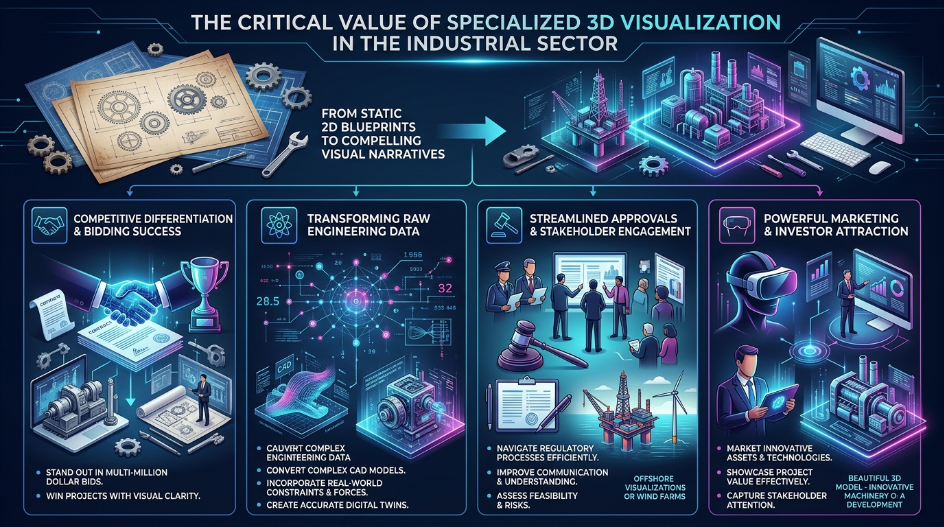
In today’s fast-paced, technology-driven industrial landscape, relying on static, cumbersome 2D blueprints to convey complex technical concepts is no longer sufficient. Whether you are bidding on a multi-million dollar subsea installation project, navigating regulatory approval processes, or marketing an innovative offshore asset, visual clarity is your primary competitive differentiator. Partnering with a specialized 3D visualization company bridges the gap between raw engineering data and compelling, photorealistic visual narratives. A professional 3D studio does more than produce “pretty pictures”; it transforms complex CAD models, hydrodynamic forces, geotechnical constraints, and mechanical motions into highly accurate interactive digital twins and cinematic animations.
From offshore oil and gas rigs and renewable wind farm developments to high-end industrial machinery and architecture, high-quality 3D assets fundamentally change how stakeholders perceive project value, risk, and feasibility. Join us in this article from Fidar Animation as we explore how to ensure your project stands out in the competitive global market.
What Does a Top-Tier 3D Visualization Company Do?
A modern 3D visualization firm acts as a multi-disciplinary strategic partner that combines CGI (Computer Generated Imagery), creative direction, and deep engineering literacy. A professional studio does not just offer generic graphics; it delivers comprehensive visual development solutions tailored to specific commercial and operational goals. Their scope goes far beyond basic modeling—they are, in effect, translators of complex data. Key services include:
- Photorealistic 3D Rendering: Producing high-resolution, static imagery for marketing brochures, investment presentations, environmental impact assessments, and web presence, featuring physically accurate lighting and real-world textures.
- Technical & Process Animation: Creating cinematic, dynamic videos that visualize complex assembly sequences, fluid/gas dynamics, subsea installation procedures, and heavy-lift operations.
- Interactive & Real-Time 3D Applications: Developing interactive models based on Unreal Engine and Unity that allow clients to explore platforms, inspect components, and simulate operations in real-time.
- Virtual Reality (VR) & Augmented Reality (AR): Providing immersive environments for offshore personnel training, safety maneuvers, remote client site tours, and interactive exhibitions.
- Engineering & Architectural Digital Twins: Building data-rich, visually accurate 3D models integrated with operational telemetry for full project lifecycle management.
Through this comprehensive suite of services, a 3D visualization partner enables engineering teams and corporate sales managers to clearly explain high-risk operations, eliminate ambiguities, and secure project approvals with speed and confidence. They serve as an extension of your own engineering unit, ensuring that the visual output is not just “beautiful,” but technically accurate down to the last bolt and weld.
The Strategic Business Value for Engineering and Offshore Sectors
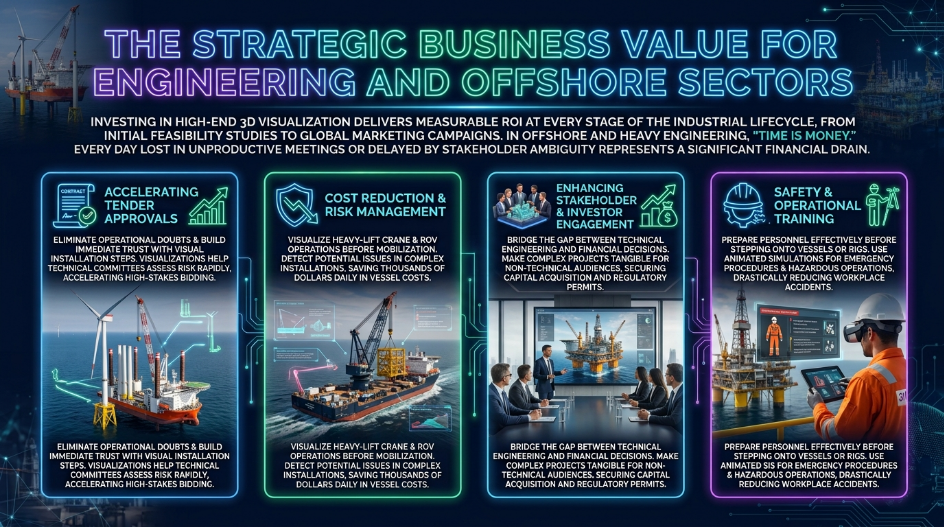
Investing in high-end 3D visualization delivers measurable ROI at every stage of the industrial lifecycle, from initial feasibility studies to global marketing campaigns. In offshore and heavy engineering, “time is money.” Every day lost in unproductive meetings or delayed by stakeholder ambiguity represents a significant financial drain.
- Accelerating Tender Approvals: In high-stakes tenders for offshore wind installations, subsea pipelaying, or oilfield services, technical committees must assess risk rapidly. An animation visualizing installation steps creates immediate trust, eliminates operational doubts, and accelerates the bidding process.
- Cost Reduction & Risk Management: Virtual staging of heavy-lift cranes or ROV (Remotely Operated Vehicle) operations reveals spatial clashes and logistical bottlenecks before expensive maritime vessels are mobilized, saving thousands of dollars daily.
- Enhancing Stakeholder & Investor Engagement: Non-technical decision-makers, financial backers, and government environmental bodies rarely interpret engineering blueprints correctly. Photorealistic visual storytelling makes project feasibility tangible, facilitating capital acquisition and regulatory permitting.
- Safety & Operational Training: Animations illustrating emergency shutdown procedures, deepwater intervention, or hazardous area operations ensure personnel are prepared before stepping onto a vessel or rig, drastically reducing the risk of workplace accidents.
The Production Process: Turning Raw Data into Visual Content
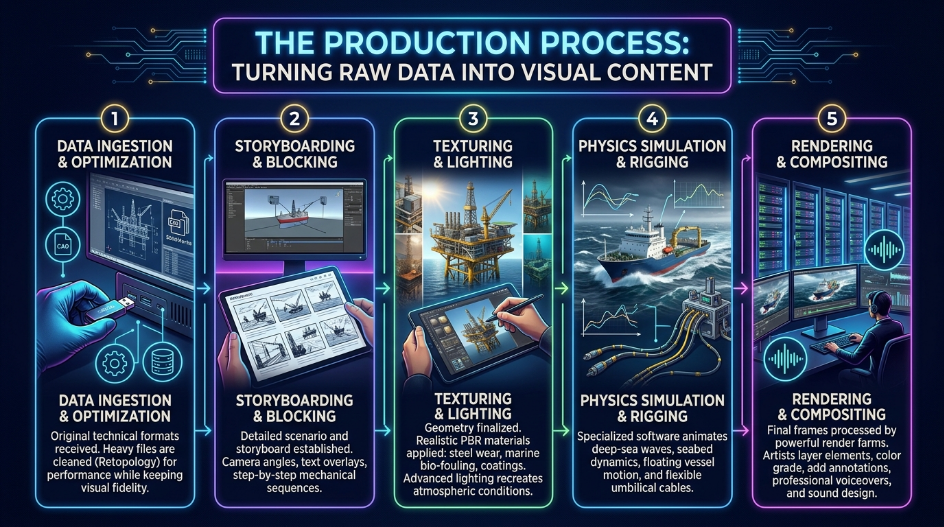
A standard rendering and digital simulation production pipeline consists of the following phases:
- Data Ingestion & Optimization: The process begins with technical data transfer. The 3D firm receives original engineering formats like CAD or SolidWorks files. Since these are often too heavy for visual software, the team performs retopology and optimization to maintain visual fidelity while ensuring smooth software performance.
- Storyboarding & Blocking: A detailed scenario and storyboard are established. Here, camera angles, text overlays, technical descriptions, and step-by-step mechanical sequences are defined. Blocking out the 3D scene ensures spatial relationships, vessel movements, and camera paths are verified before final production.
- Texturing & Lighting: Once geometry is finalized, artists apply realistic PBR (Physically Based Rendering) materials. This includes simulating steel wear, marine bio-fouling, and structural coatings. Advanced lighting systems are designed to recreate precise atmospheric conditions, such as harsh midday sun at sea or the dim conditions of the deep ocean.
- Physics Simulation & Rigging: Offshore environments require extensive physical simulation. Specialized software is used to animate deep-sea waves, seabed dynamics, floating vessel motion (heave, pitch, and roll), and flexible umbilical cables.
- Rendering & Compositing: Final frames are processed using powerful render farms. Artists then handle post-production, layering elements, performing color grading, adding engineering annotations, and incorporating professional voiceovers and sound design to create a high-impact final asset.
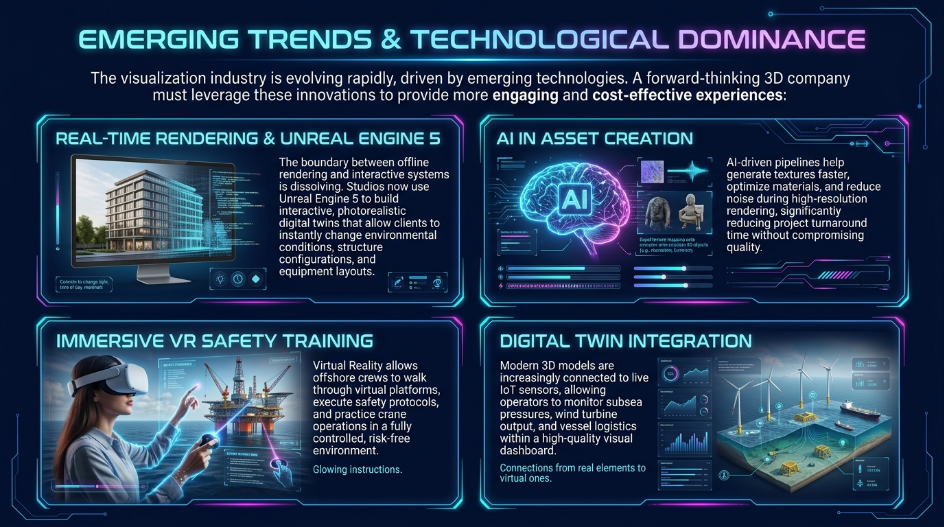
Emerging Trends & Technological Dominance
The visualization industry is evolving rapidly, driven by emerging technologies. A forward-thinking 3D company must leverage these innovations to provide more engaging and cost-effective experiences:
- Real-Time Rendering & Unreal Engine 5: The boundary between offline rendering and interactive systems is dissolving. Studios now use Unreal Engine 5 to build interactive, photorealistic digital twins that allow clients to instantly change environmental conditions, structure configurations, and equipment layouts.
- AI in Asset Creation: AI-driven pipelines help generate textures faster, optimize materials, and reduce noise during high-resolution rendering, significantly reducing project turnaround time without compromising quality.
- Immersive VR Safety Training: Virtual Reality allows offshore crews to walk through virtual platforms, execute safety protocols, and practice crane operations in a fully controlled, risk-free environment.
- Digital Twin Integration: Modern 3D models are increasingly connected to live IoT sensors, allowing operators to monitor subsea pressures, wind turbine output, and vessel logistics within a high-quality visual dashboard.
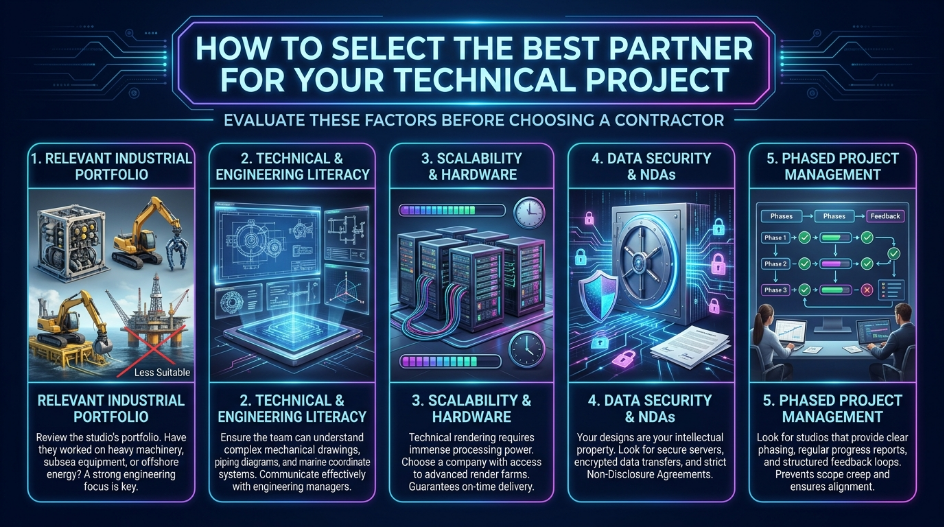
How to Select the Best Partner for Your Technical Project
Choosing the right partner is critical to the success of your expensive, high-stakes technical projects. Evaluate the following before choosing a contractor:
- Relevant Industrial Portfolio: Review the studio’s portfolio. Have they worked on heavy machinery, subsea equipment, or offshore energy? If 90% of their work is interior design, they will likely struggle with subsea physics simulation.
- Technical & Engineering Literacy: Ensure the team can understand complex mechanical drawings, piping diagrams, and marine coordinate systems. The ability to communicate effectively with your engineering manager is paramount.
- Scalability & Hardware: Technical rendering requires immense processing power. Choose a company with access to advanced render farms to guarantee on-time delivery.
- Data Security & NDAs: Your designs are your intellectual property. Ensure the chosen studio provides secure servers, encrypted data transfers, and strict Non-Disclosure Agreements.
- Phased Project Management: Look for studios that provide clear phasing, regular progress reports, and structured feedback loops to prevent scope creep and ensure alignment.
Conclusion
As industrial projects grow more complex and international market competition intensifies, visual clarity is no longer optional—it is a vital competitive and commercial advantage. Partnering with a specialized 3D visualization company ensures that your engineering achievements are communicated with maximum visual impact, absolute technical precision, and strategic business effectiveness.
At Fidar Animation, we specialize in transforming complex offshore and industrial engineering concepts into clear, compelling, and high-quality visual assets. We deeply understand the unique challenges of the marine, subsea, and heavy energy industries. Our team doesn’t just render images; we understand the physics of your industry. Whether you need high-impact renders for tenders, realistic training animations for subsea operations, or interactive digital twins, Fidar Animation delivers industrial precision and exceptional visual quality.
Are you ready to elevate your technical assets and streamline your next tender process?
Don’t let complex engineering ideas get lost in translation. Partner with a team that speaks your language and understands your technology.
Contact Fidar Animation today to discuss your project requirements.