
In the fast-paced world of engineering and heavy industry, communicating business concepts is a challenging and demanding task for individuals. While we at Fidar Animation pride ourselves on our expertise in stunning 3D designs of ships and offshore animation, we understand that sometimes realism is not the answer. In industries such as oil, gas, petrochemicals and renewable energy, there is a need to show flows, reactions and internal circuits that are not visible to the naked eye.
This is where 2D energy animation comes into play as a strategic tool. This comprehensive article takes an in-depth look at this powerful medium and shows why leading energy and offshore companies are turning to 2D motion graphics to train staff and market their projects.
What is 2D energy animation?
2D energy animation is a branch of industrial animation that focuses on schematic clarity rather than the volume, realistic lighting, and complex textures common in our 3D work. This type of animation uses vector graphics, icons, and moving diagrams to explain the processes of energy production, distribution, and consumption.
In marine and energy engineering, many processes occur inside pipes, cables, or tanks:
• The flow of electrons in a smart grid.
• Fluid dynamics in a submarine pipeline.
• Chemical separation processes in a floating refinery.
2D animation cuts through the layers of reality and gets straight to the logic of the process. This style is the visual language of engineers brought to life, allowing engineers to present complex concepts to their audiences in a simple and straightforward way.
Why does the energy industry need 2D animation?
Industrial content needs to be accurate and reliable. 2D animation helps the energy industry in four key ways:
1. Simplifying invisible processes
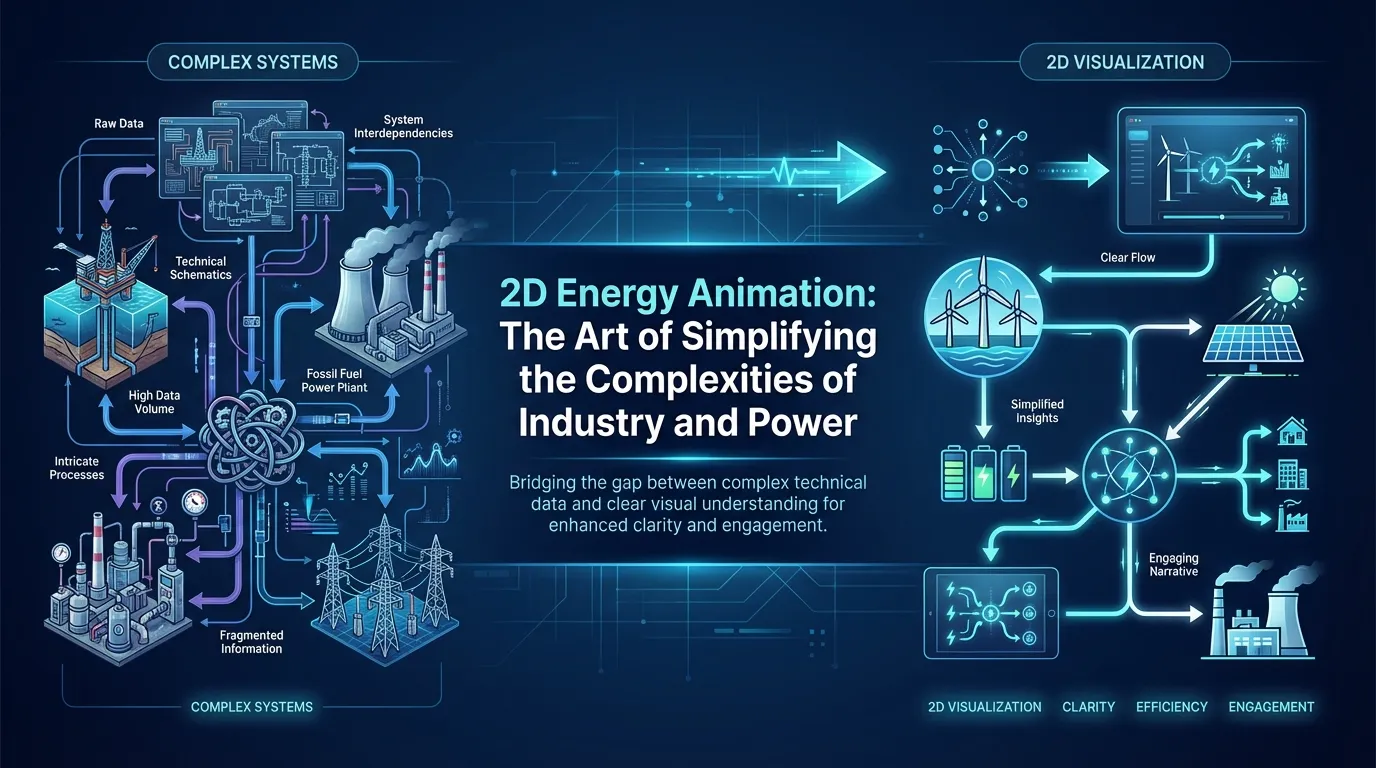
You can’t see electricity, but you can feel its effects. In a 2D animation, we use conventional colors (e.g. blue for cold water, red for steam, yellow for electricity) to show the path of energy flow. This is crucial for explaining how offshore wind turbines or hybrid ship propulsion systems work.
2. Reducing cognitive load
In B2B marketing, your audience of technical managers and investors has little time. 3D animation is great with its stunning detail, but sometimes too much detail can distract from the main message. 2D animation with flat design or isometrics removes all visual noise and puts 100% focus on the data and function.
3. Flexibility to change
Energy projects are constantly changing. Editing a rendered 3D animation is very time-consuming and expensive. In contrast, 2D animations, usually created with software such as After Effects, are very quick to edit. If engineers change the piping plan, the 2D animation can be updated in a matter of hours.
4. Cost-effective
For clean energy startups or companies that need to produce mass educational content, budget is important. 2D animation has a lower production cost than advanced 3D simulations, without sacrificing its educational or promotional value.
Key applications of 2D animation in the marine and energy industries
As ship design experts, we at Fidar Animation know that ships are not just “vehicles”; they are mobile power plants. The applications of 2D animation at this intersection (energy + sea) are vast:
1. Offshore Oil and Gas
Showing Geological Structure: Using 2D cross-sections to show the oil layers of the seabed and how drilling rigs work.
Explaining how oil, gas and water are separated in well separators. These processes occur in a confined space and 2D animation is the best way to see inside the device.
2. Offshore Renewable Energy
• Floating Wind Turbines: A schematic representation of how electricity is transmitted from the turbine to the offshore high-voltage substations and then to the onshore grid.
• Wave Energy Converters: Explaining the complex mechanical mechanisms that convert wave motion into electricity. Using motion graphics to show the force vectors is very effective here.
3. Ship Propulsion Systems and Engine Houses
• Dual-Fuel Engines: Explaining the combustion cycle and how to switch between diesel and LNG fuel.
• Scrubber Systems: A chemical demonstration of the process of removing sulfur from ships’ exhaust fumes to meet IMO standards.
• Balanced water management: Schematic illustration of the water inflow and outflow cycle and UV or electrolysis purification systems.
Visual and technical standards in energy animation production
For an energy animation to be professional and at the level of world standards, it must follow certain principles. At Fidar Animation, we believe that visual quality directly affects the brand’s reputation.
1. Industrial color palette
It is wrong to use neon or cartoon colors in industrial work. The color palette should:
• Match the corporate identity of the energy company.
• Follow standard engineering color codes so that engineers can quickly understand the content.
2. Isometric style
The isometric style is a bridge between 2D and 3D. This style has no perspective and parallel lines do not converge, but it gives a sense of depth. This is the best style for displaying petrochemical plants, oil rigs, and site maps, as it accurately shows the scales.
3. Dynamic Infographics
An energy animation shouldn’t just be a moving image; it should contain data. Integrating numbers, graphs, and pressure gauges that move with the animation multiplies the informative value of the video.
2D Energy Animation Production Process: From Concept to Output
Transparency in the production process is a sign of expertise. We divide the production process into the following steps so that clients know exactly what they are getting:
Step 1: Technical Scenario
Unlike TV commercials, an energy animation scenario is not written by typical copywriters. This requires direct interaction with project engineers. We study technical documents, CAD drawings, and P&ID (Plumbing and Instrumentation Diagrams) to ensure that the scenario is 100% scientifically accurate.
Step 2: Schematic Storyboard
Before any animation, a storyboard is designed. In this step, we determine what flow is shown at each second. Do the arrows show the direction of gas flow? Does the tank change color as it fills? It is critical that this step is approved by the client’s technical team.
Step 3: Asset Design
Our graphics team designs all the components (turbines, pipes, molecules, ships) as vectors. These vectors are infinitely scalable and do not lose quality (unlike pixelated images).
Step 4: Animate and Motion
This is where the magic happens. Using advanced software, we simulate the laws of physics. Timing is key in energy animation. The speed of the animation should match reality or be adjusted so that fast processes are understandable.
Step 5: Industrial Voiceover
The soundtrack should not be distracting. Sound effects (turbine noise, water flow, clicks of switches) give weight to the 2D animation and create an industrial feel. The narration should be delivered in an authoritative and educational tone.
How to Choose the Right Animation Studio?
If you are working in the field of ship design, energy or heavy industry, entrusting the project to a typical advertising agency is a big risk. They may know motion, but they do not know engineering. To choose the right team, look for these characteristics:
1. Technical understanding: Do they know the difference between a compressor and a turbine?
2. Industry Portfolio: Have they done similar projects for the energy or marine sector before?
3. Approval Process: Is there a stage to confirm the scientific accuracy of the scenario?
4. Blending Capability: Can they combine 2D animation with 3D renderings if needed?
At Fidar Animation, we have done our best to deliver a flawless project, utilizing a team of engineers and experts in this field, and we are by your side from zero to one hundred projects.
The Power of Storytelling in the Industry
2D energy animation is not just about moving images; it is about translating the complex language of engineering into the universal language of visuals. In industries like shipping, oil and power, where mistakes are costly, clarity and transparency are the most valuable assets.
At Fidar Animation, we are on a mission to tell the story of your projects in the most eloquent way possible by combining digital art and engineering knowledge. Whether you need a realistic 3D model of a supertanker or a detailed 2D motion graphic of its fuel system, our team is ready to make your vision a reality.
If you’re ready to transform the technical complexities of your project into a powerful marketing tool, contact us today.